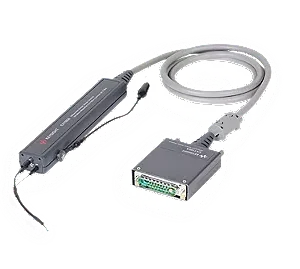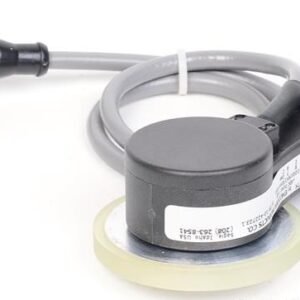

The Tektronix A6303XL is an active current probe engineered for AC and DC current measurement across DC to 10 MHz. Featuring a split-core design for non-invasive clamping around conductors up to 21.1 mm diameter, the probe accommodates continuous currents to 100 A and peak transients to 500 A. The 8 meter cable extends measurement reach in confined or distributed test environments. Hall effect sensing handles DC components while a ferrite transformer captures AC signals; bucking current from the amplifier eliminates core saturation and extends dynamic range. Rise time of ≤35 ns supports fast transient analysis, and the 10,000 A·µs amp-second product rating accommodates moderate pulse loading. Compatible exclusively with Tektronix AM503B and AM5030 Current Probe Amplifiers, the A6303XL integrates into established measurement systems for motor drives, inverters, power supplies, and transportation applications.
Technical Specifications
• Bandwidth: DC to 10 MHz
• Continuous Current Rating: Up to 100 A
• Peak Current Rating: Up to 500 A
• Rise Time: ≤35 ns
• Amp-Second Product: 10,000 A·µs
• Conductor Diameter Limit: Up to 21.1 mm (0.83 in.)
• Cable Length: 8 meters (26.2 feet)
• Probe Type: Active
– Key Features
• Split-core jaw design enables clamping without circuit interruption
• Dual-sensing architecture: Hall effect for DC, ferrite transformer for AC
• Bucking current (100 A from amplifier) eliminates saturation effects
• Extended 8 meter cable for remote measurement points
• Accepts standard industrial conductor sizes to 0.83 inches
– Typical Applications
• Motor drive and inverter current profiling
• Power supply transient analysis
• Transportation system power validation
• DC and AC mixed-signal current measurement
– Compatibility & Integration
The A6303XL operates exclusively with the Tektronix AM503B and AM5030 Current Probe Amplifiers. Not compatible with AM503, AM503A, or 11A16 systems. The probe jaw slide must lock during measurement; an unlocked slide triggers the PROBE OPEN indicator on the amplifier. Never disconnect the probe from a live conductor, and ensure power removal before clamping onto uninsulated wires.