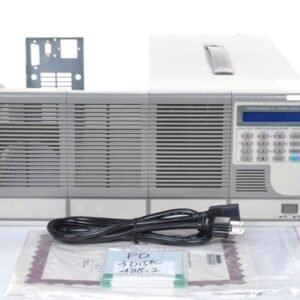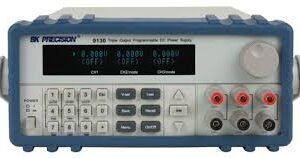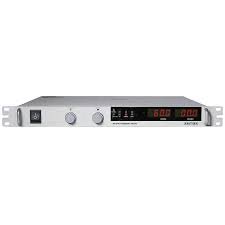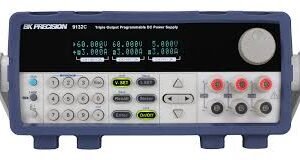

The Tektronix PS2520G is a programmable triple-output DC power supply engineered for precision testing, measurement, and development across research, manufacturing, and educational settings. Three independent outputs deliver flexible voltage and current configurations, while GPIB remote programmability and SCPI command compatibility enable automated test sequences and integrated instrument control. User-configurable overvoltage and overcurrent protection, combined with 100 memory slots for stored settings, support repeatable test protocols and production workflows.
Technical Specifications
Output Configuration
• Output 1: 0 to 6 V, 0 to 3 A
• Output 2: 0 to 36 V, 0 to 1.5 A
• Output 3: 0 to 36 V, 0 to 1.5 A
Performance
• Voltage accuracy: ±0.05% + 5 mV
• Current accuracy: ±0.2% + 10 mA
• Programmable voltage resolution: 10 mV
• Dual 4-digit LED displays for voltage and current monitoring
Operating Modes
Independent, series, or parallel connection of variable outputs allows adaptation to single-device testing or multi-rail load requirements.
– Key Features
• GPIB Interface: Remote operation and full programmability via Standard Commands for Programmable Instruments (SCPI)
• Memory Storage: 100 preset slots accessible from front panel or GPIB for rapid configuration switching
• Front Panel Control: Push-button and numeric keypad interface for manual voltage and current limit adjustment
• Protection: User-configurable overvoltage protection (OVP) and overcurrent protection (OCP) with pre-power setting capability
• Output Control: Individual ON/OFF switching per output
• Selectable Line Voltage: Input voltage setting accommodates different facility power standards
– Typical Applications
• Training and educational instruction
• Manufacturing production testing and verification
• Field repair and troubleshooting
• Bench calibration and equipment repair
• Product design and prototype validation
• Laboratory and research environments
– Compatibility & Integration
GPIB connectivity and SCPI command set enable integration into automated test systems and allow coordination with other programmable instruments in multi-instrument measurement setups.