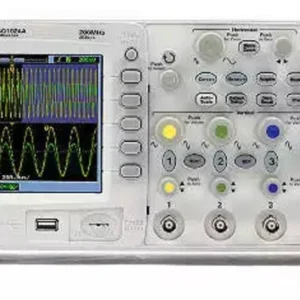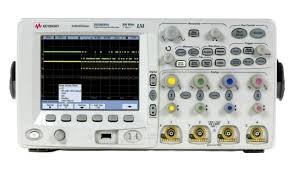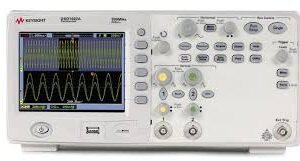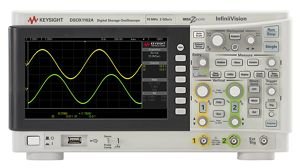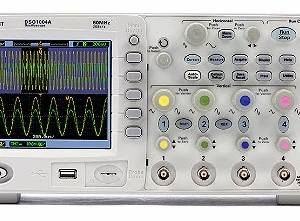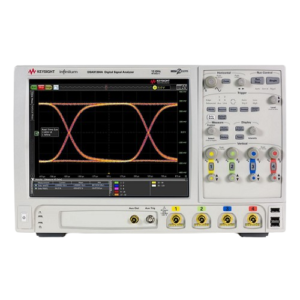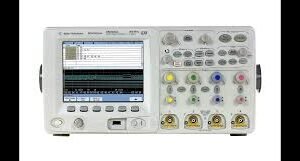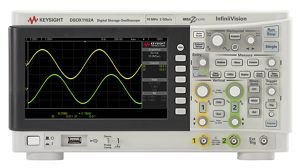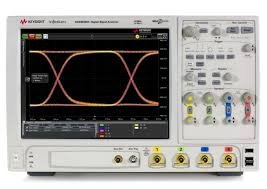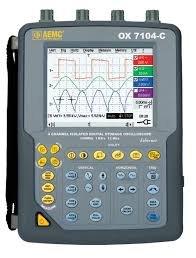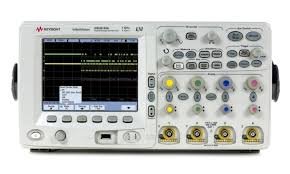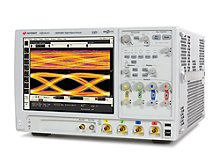

The Tektronix TDS7104 is a 1 GHz, 4-channel digital phosphor oscilloscope built for high-speed signal characterization, timing analysis, and serial protocol debugging. It acquires waveforms at up to 20 GS/s with 32 Megasamples of memory, capturing transient events at >400,000 waveforms per second. Deep memory, exceptional jitter analysis to 1.5 ps RMS, and advanced triggering—including 32-bit serial, glitch, width, and runt detection—enable isolation of intermittent faults and pattern-dependent anomalies in complex designs. The instrument integrates arithmetic, calculus, and frequency-domain analysis functions with multiple waveform display modes. An open Windows environment and external reference input support integration into existing test workflows and multi-instrument synchronization.
Technical Specifications
Acquisition
• Bandwidth: 1 GHz
• Channels: 4
• Real-time sample rate: Up to 20 GS/s (10 GS/s per channel)
• Memory depth: Up to 32 Megasamples; optionally up to 64 MB with MultiView Zoom
• Waveform capture rate: >400,000 wfms/second
• Vertical resolution: 8-bit standard; >11-bit with averaging
Timebase
• Range: 200 ps/div to 40 s/div (alternate: 50 ps/div to 10 s/div)
• Delay time: 16 ns to 250 s
• Channel-to-channel deskew: ±25 ns
• External reference input: 10 MHz (rear-panel BNC)
Triggering
• Serial trigger: 32-bit pattern detection for fault isolation
• Glitch trigger: Detects pulses as narrow as 1.0 ns with 200 ps resolution; supports positive, negative, or either polarity
• Width trigger: 1 ns to 1 s selectable limits
• Runt trigger: Threshold-crossing detection and classification
Analysis
• Jitter measurement: 1.5 ps RMS capability
• Waveform styles: Vectors, dots, intensified samples, variable and infinite persistence
• Functions: Arithmetic (add, subtract, multiply, divide), calculus (integrate, differentiate), FFT with eight window types
• Communications mask testing: Up to 2.5 Gbps
– Key Features
• High-speed jitter and timing analysis with picosecond-level accuracy
• Multi-gigabit serial protocol triggering and characterization
• Deep acquisition memory minimizes dead time between captures
• Flexible external reference input for lab synchronization
• Windows-based application environment