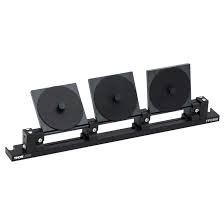

The ThorLabs FPC560 is a manual fiber polarization controller that converts arbitrary input polarization states to any desired output by stress-induced birefringence. Three independently rotatable paddles loop optical fiber around spools with a 2.2″ (56 mm) diameter, creating three fractional wave plates. Each paddle rotates ±117.5° to adjust ellipticity and orientation of polarization with stable, repeatable performance. The larger spool diameter minimizes bending stress, making the FPC560 ideal for fibers exhibiting higher bend loss. The controller accepts single-mode fiber with a Ø900 µm jacket—bare fiber or jacketed up to Ø900 µm—and is sold as an empty unit for user fiber installation.
Technical Specifications
• Type: Manual fiber polarization controller
• Operating Wavelength Range: 500–1600 nm
• Spool Configuration: Three paddles, loop diameter 2.2″ (56 mm)
• Paddle Rotation: ±117.5° per paddle
• Fiber Compatibility: Single-mode fiber, Ø900 µm jacket maximum
• Minimum Fiber Length: 5 m recommended for FPC560
• Loop Configuration: 3 to 4 loops per paddle recommended for shorter wavelengths
• Construction: Delrin plastic paddles, aluminum base
– Key Features
• Converts arbitrary to target polarization states through three independent retarders
• Adjusts both ellipticity and polarization orientation
• Large spool diameter reduces bend-induced losses in high-loss fibers
• Birefringence magnitude depends on wavelength, loop count, and fiber type
• Fast axis orientation controlled via paddle rotation; fast axis lies in spool plane
– Typical Applications
• Polarization state generation and control in single-mode optical systems
• Fine-tuning of arbitrary input states across visible to near-infrared wavelengths
• Integration into fiber-based measurement and test configurations
– Compatibility & Integration
The FPC560 accepts standard single-mode patch cables with FC/PC or FC/APC connectors and Ø900 µm jackets. Users install fiber independently; minimum 5 m of fiber is recommended. Birefringence per paddle scales with loop count, enabling customization for specific wavelength ranges within 500–1600 nm.