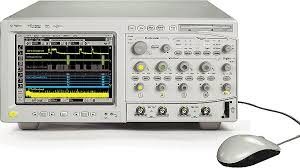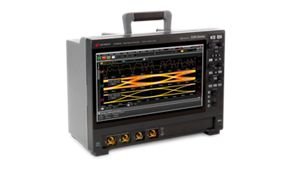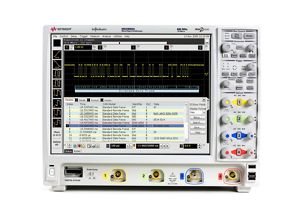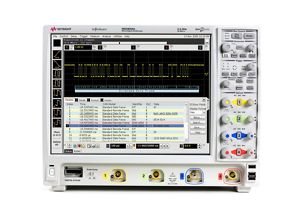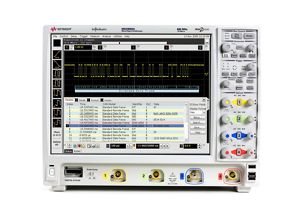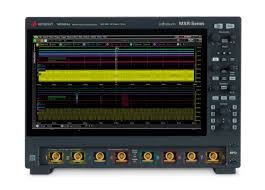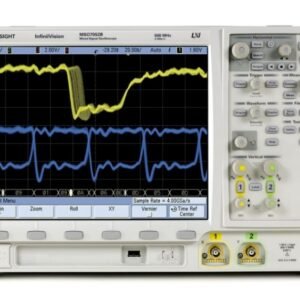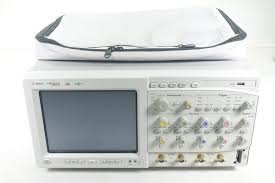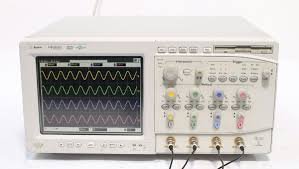
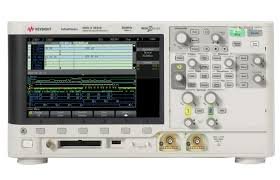

The Keysight MSOX3032T is a 350 MHz mixed-signal oscilloscope built for engineers analyzing complex signals across analog and digital domains simultaneously. This instrument combines 2 analog channels with 16 digital channels to deliver complete visibility into embedded systems, microcontroller designs, and multi-protocol debugging scenarios. The 8.5-inch capacitive touch display with gesture support provides intuitive access to triggering controls and waveform analysis tools. Maximum sampling reaches 5 GSa/s on single channels, dropping to 2.5 GSa/s when both analog inputs are active. Memory depth of 4 Mpts per channel—reduced to 2 Mpts with both analog channels in use—supports deep acquisitions for transient capture and statistical analysis.
Technical Specifications
• Bandwidth: 350 MHz
• Analog Channels: 2
• Digital Channels: 16 (MSO feature)
• Maximum Sampling Rate: 5 GSa/s (single channel); 2.5 GSa/s (dual analog)
• Memory Depth: 4 Mpts (single analog); 2 Mpts (dual analog)
• Waveform Update Rate: 1,000,000 waveforms/second
• Display: 8.5-inch color TFT LCD with capacitive touch and gesture support
• Input Voltage: 100 V to 240 V
• Physical: 381 mm × 142 mm × 204 mm; 4 kg
– Key Features
• Zone Touch Triggering for rapid signal isolation
• Serial protocol triggering and analysis: I2C, SPI, RS232/422/485/UART, CAN, CAN FD, LIN, SENT, CXPI, FlexRay, MIL-STD 1553, ARINC 429, USB PD, I2S
• Optional 20 MHz arbitrary/function waveform generator with sine, square, ramp, pulse, DC, Sinc(x), exponential, cardiac, Gaussian, and noise waveforms
• Mask testing capability
• 3-digit voltmeter option
• Passive probes included: one 500 MHz, 10:1 per analog channel
• 16-channel MSO cable included
• 3-year calibration interval
– Typical Applications
Embedded system debug, microcontroller signal validation, mixed-signal protocol analysis, power supply transient measurement, and multi-channel digital state correlation.
– Compatibility & Integration
USB connectivity supports external control and data transfer. Modular upgrade path allows addition of waveform generation, protocol analysis, and measurement functions without instrument replacement.