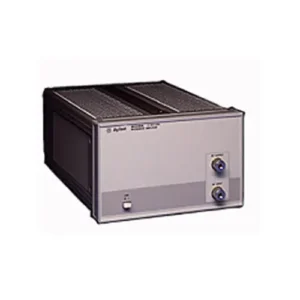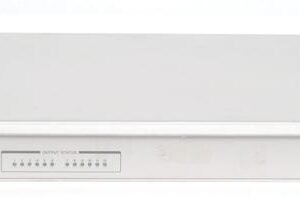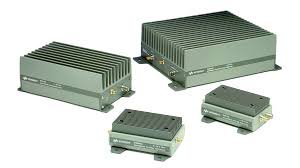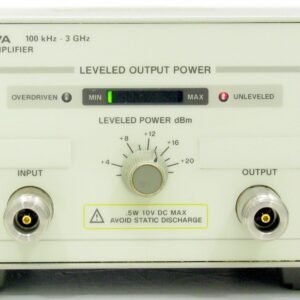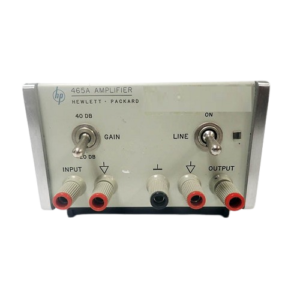
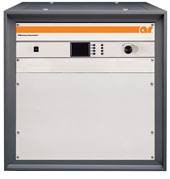

The Amplifier Research 250S1G4 is a solid-state, air-cooled broadband amplifier delivering 250 watts of RF power across 0.8 to 4.2 GHz with instantaneous bandwidth. Push-pull power stage circuitry provides inherent stability and reduced distortion, making this self-contained unit ideal for driver applications, wireless component testing, and EMC measurements. The amplifier faithfully reproduces AM, FM, and pulse modulation while maintaining low spurious signal levels and high linearity across supported protocols including CDMA, W-CDMA, TDMA, and GSM.
Technical Specifications
• Output Power: 250 watts minimum
• Frequency Range: 0.8 to 4.2 GHz (instantaneous bandwidth)
• Gain: 54 dB minimum at maximum setting; 15 dB minimum adjustment range
• Harmonic Distortion: −20 dBc maximum at 225 watts
• Third Order Intercept Point: 64 dBm typical
• Input Level for Rated Output: 1.0 mW maximum
• Input Impedance: 50 Ω, VSWR 2.0:1 maximum
• Output Impedance: 50 Ω nominal
• Mismatch Tolerance: Full capacity operation into load ratios as high as 6.0:1 VSWR without foldback circuitry
• Primary Power: Selectable 90–132 VAC or 180–264 VAC, 50/60 Hz, single phase; maximum consumption 250 watts
– Key Features
• RF connectors: Type N female
• Digital Control Panel with graphic LCD displaying forward power, reflected power, and amplifier status
• Local and remote control via menu-assigned inputs
• Multiple remote interfaces: IEEE-488 (GPIB), RS-232, fiber optic (ST connector), USB 2.0 Type B, and Ethernet RJ-45
• Benchtop design with removable cabinet for rack mounting
• Air-cooled operation suitable for indoor environments up to 2000 m altitude
• Operating temperature: 5°C to 40°C; maximum relative humidity 80% (50% at 40°C)
– Typical Applications
• Driver amplification for wireless component and subsystem testing
• Modulated signal delivery for CDMA, W-CDMA, TDMA, and GSM systems
• EMC and radiated immunity testing
• Communication technology validation requiring undistorted modulation envelopes
– Compatibility & Integration
The amplifier integrates with test systems via GPIB, RS-232 (copper and fiber), USB 2.0, and Ethernet. Safety interlock via 15-pin female subminiature D connector on rear panel. Operator control through RJ-11 interface.