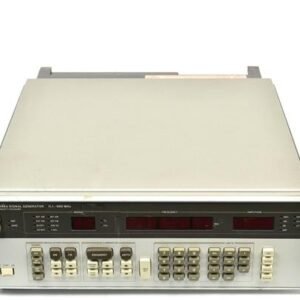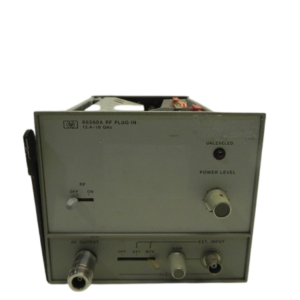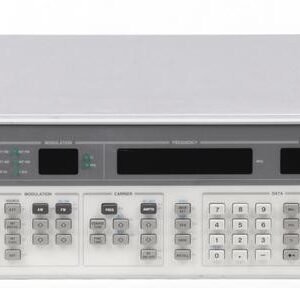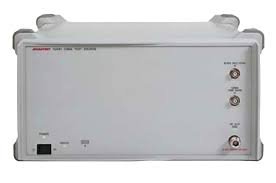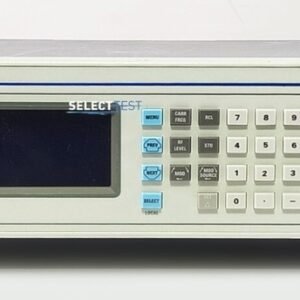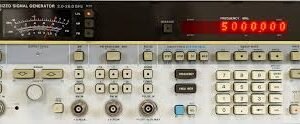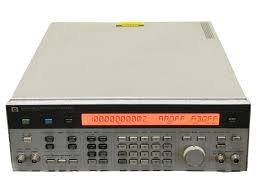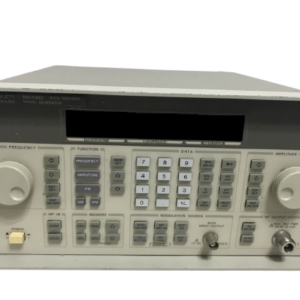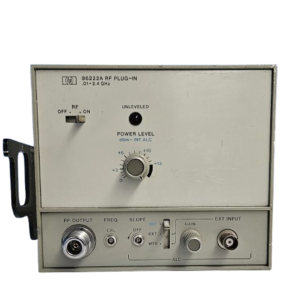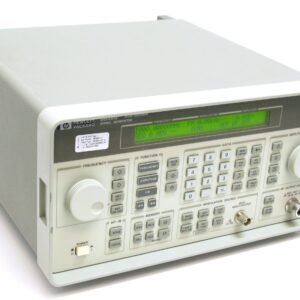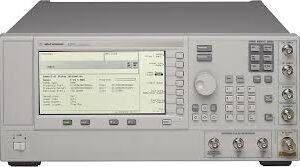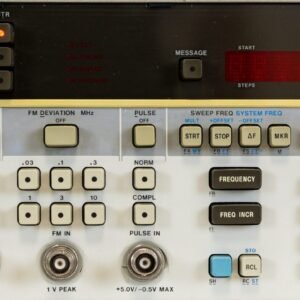
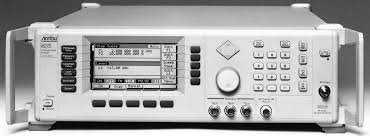

The Anritsu 68037C Synthesized CW Generator delivers continuous wave signals across 2–20 GHz with ultra-low phase noise and precise output power leveling. Built for RF and microwave validation, R&D, and automated test environments, it combines configurable architecture with straightforward local oscillator replacement capability or advanced signal generation for demanding applications.
Technical Specifications
Frequency and Output
• Frequency range: 2 GHz to 20 GHz
• Output power: +17 dBm maximum, –125 dBm minimum
• Output accuracy: Leveled power to +17 dBm up to 20 GHz
• Frequency resolution: 1 kHz standard; 0.1 Hz optional (Option 11)
Signal Purity
• Phase noise: –107 dBc at 10 kHz offset from 10 GHz
• Spurious signals: Ultra-low levels
Modulation and Sweep
• Modulation: Internal AM, FM, phase modulation (øM), and pulse modulation; user-downloaded arbitrary modulation supported
• Internal pulse generator: Doublet, triplet, or quadruplet pulses for RADAR blind spot testing
• Sweep modes: CW, step sweep, digital frequency sweep, digital power sweep, alternate sweep, and manual sweep
• Step sweep dwell time: 1 ms/step to 99 seconds/step (starts after phase lock)
• Switching time: <5 ms for <100 MHz steps; <15 ms + 1 ms/GHz for larger steps or <40 ms maximum
Control and Integration
• List mode: Internal execution reduces ATE controller overhead
• Programmability: Optional SCPI compatibility with IVICOM and LabVIEW drivers
• Form factor: Rackmount
– Key Features
• Exceptional phase noise performance at –107 dBc (10 kHz offset)
• Fast frequency switching <5 ms for narrow bandwidths
• Flexible dwell times from 1 ms to 99 seconds per step
• Pulse modulation with multi-pulse generation for radar applications
• List mode operation for autonomous signal sequencing
– Typical Applications
Component validation, RF receiver testing, local oscillator replacement, automated test equipment integration, and radar system characterization.
– Compatibility & Integration
Optional SCPI commands enable direct ATE integration. Available drivers include IVICOM and National Instruments LabVIEW. Option 2A adds 10 dB/step attenuation; Option 11 enables 0.1 Hz resolution.