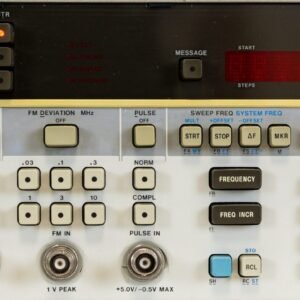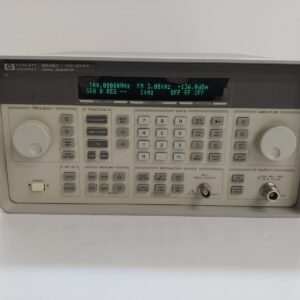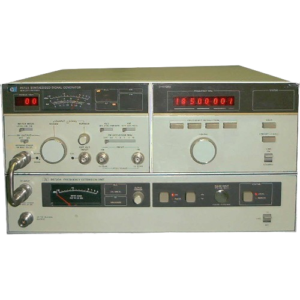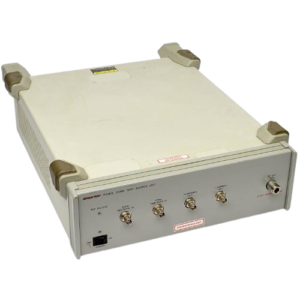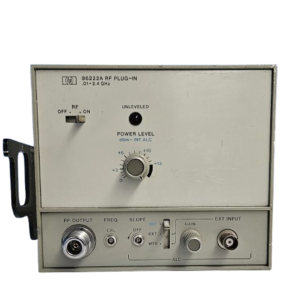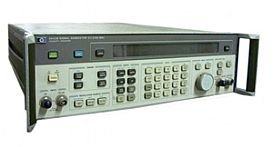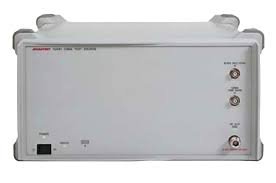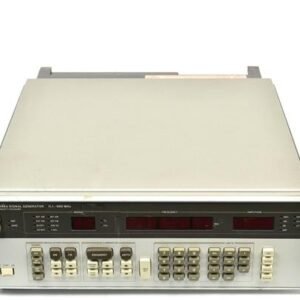
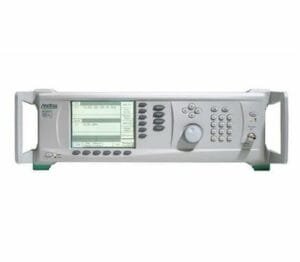

The Anritsu 68077B is a synthesized CW generator delivering wideband RF and microwave stimulus from 10 MHz to 50 GHz. Built for local oscillator replacement, CW stimulus, and swept measurements in automated test equipment environments, it combines fast frequency agility with ultra-low phase noise and flexible modulation. The instrument executes phase-locked step sweeps across up to 10,000 steps with switching times under 15 ms plus 1 ms per GHz, or under 5 ms for steps below 100 MHz. Programmable frequency agility stores up to 1,000 non-sequential frequencies for rapid addressed access. Internal modulation includes AM, FM, phase, and pulse; external FM (locked or unlocked) and AM (log or linear) are also supported.
Technical Specifications
• Frequency Range: 10 MHz to 50 GHz
• Frequency Resolution: 100 mHz (0.1 Hz optional)
• Output Power: +12 dBm maximum; +17 dBm guaranteed leveled to 20 GHz; -120 dBm with attenuator; -140 dBm with electronic attenuator
• SSB Phase Noise: −100 dBc at 10 kHz offset from 10 GHz
• Step Sweep: Up to 10,000 steps; 1 kHz minimum step size
• Dwell Time: 1 ms to 99 seconds per step
• Switching Time: <15 ms + 1 ms/GHz or <40 ms maximum; <5 ms for steps <100 MHz
• Frequency Agility: 1,000 stored non-sequential frequencies
• Physical Footprint: 13.3 cm compact package
– Key Features
• Dual sweep modes: CW and step sweep with analog or digital control
• Alternate sweep mode for two ranges with independent power levels
• Modulation: Internal AM, FM, phase, pulse; external FM and AM with multiple modes
• Low spurious signal performance
• Menu-driven front panel control
• SCPI programmability available
– Typical Applications
• Local oscillator replacement in receiver and transceiver testing
• CW stimulus for component and subsystem characterization
• Frequency and power sweep measurements in ATE
• Phase-locked frequency agility for rapid multi-point stimulus
– Compatibility & Integration
Free application drivers include IVICOM and National Instruments LabVIEW support, enabling direct integration into automated test systems and reducing code development time.