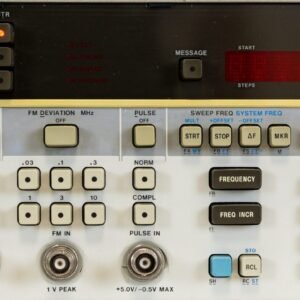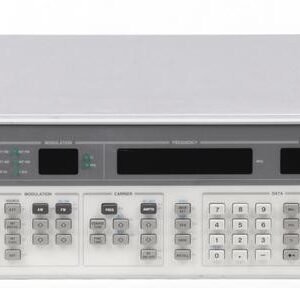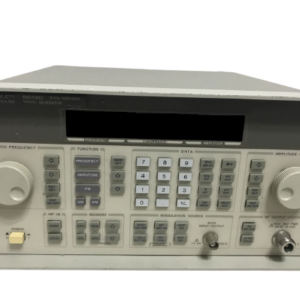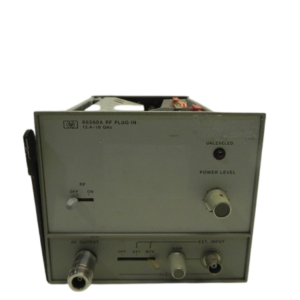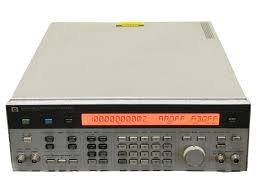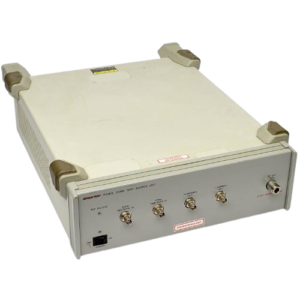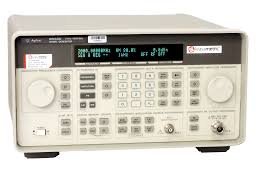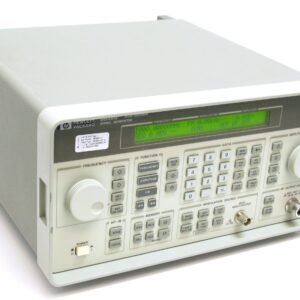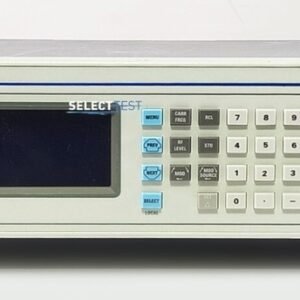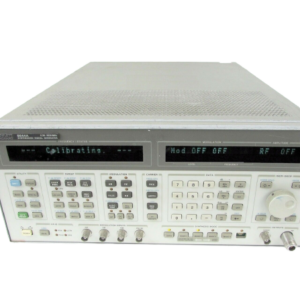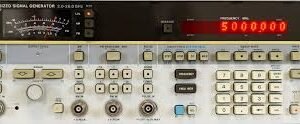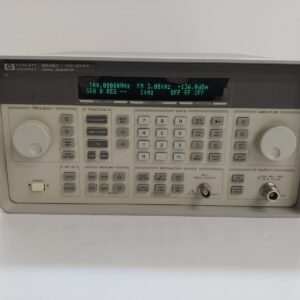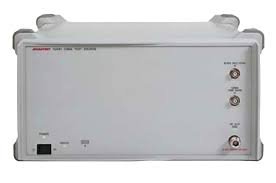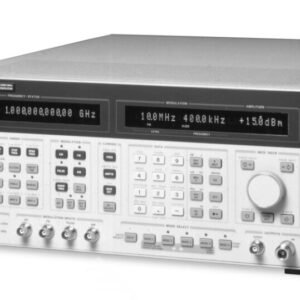
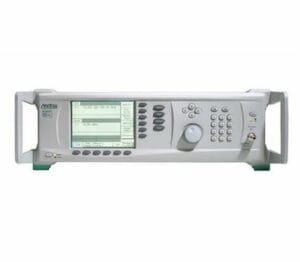

The Anritsu 68177B is a synthesized sweep generator delivering phase-locked signal generation across 0.01 to 50 GHz, with waveguide extensions supporting operation to 110 GHz. Built for precision testing in radar, telecommunications, and satellite systems, it combines ultra-low SSB phase noise of –100 dBc at 10 kHz offset from 10 GHz with flexible sweep architectures—analog, step, manual, and alternate modes—each maintaining phase lock across the swept range.
Technical Specifications
Frequency Range & Output
• 0.01 to 50 GHz (coaxial output); waveguide extensions to 110 GHz
• Maximum output power: +17 dBm
• Minimum output power: -125 dBm or -15 dBm
• Power resolution: 0.01 dB
• Output level switching time: < 15 ms + 1 ms/GHz step, < 40 ms typical maximum
Phase Noise Performance
• SSB phase noise: –100 dBc at 10 kHz offset from 10 GHz
• Single-sideband noise floor: -96 dBc/Hz to -54 dBc/Hz
• Signal purity: -40 dBc harmonics and non-harmonics
Sweep Modes
• Analog sweep: 1 kHz minimum width (0.1 Hz with Option 11) to full range, phase-locked throughout
• Step sweep: 1 to 10,000 steps with 1 kHz to full-range step size; dwell time 1 ms to 99 seconds per step
• Manual sweep: Phase-locked stepped adjustment between user-defined limits
• Alternate sweep: Dual-range operation with independent power level assignment
• Programmable frequency agility: Up to 1000 non-sequential GPIB-addressed frequencies
Modulation Capabilities
• Internal AM, FM, phase, and pulse modulation
• Seven internal waveforms including Gaussian noise and arbitrary user-defined signals
• Complex modulation via user download
• Pulse modulation supports doublet, triplet, and quadruplet configurations for RADAR testing
• Synchronized simultaneous modulation for multi-parameter signal synthesis
– Key Features
• Phase-locked operation across all sweep modes ensures frequency stability and repeatability
• Flexible step configuration from 1 to 10,000 steps with variable dwell timing
• Programmable frequency agility via GPIB for rapid, non-sequential frequency selection
• Pulse modulation optimized for radar blind spot characterization
• User-definable arbitrary waveforms for custom modulation scenarios
– Typical Applications
• Radar and electronic warfare system testing
• Telecommunications and satellite communication equipment validation
• RF component characterization and analysis
• Automatic test equipment (ATE) signal sourcing
• Signal simulation for system-level evaluation
– Compatibility & Integration
GPIB control enables remote frequency sequencing and modulation parameter adjustment. Volatile memory storage supports rapid switching between stored frequency sequences without recompilation.