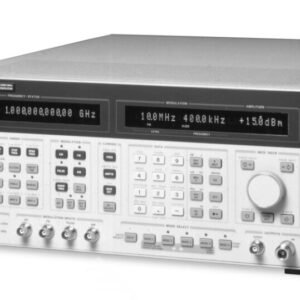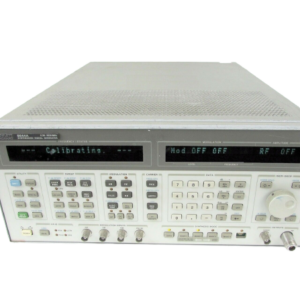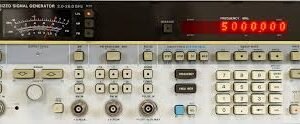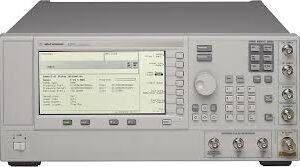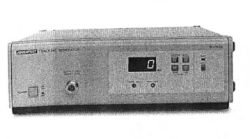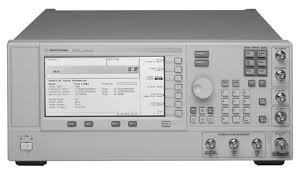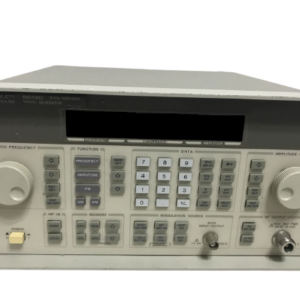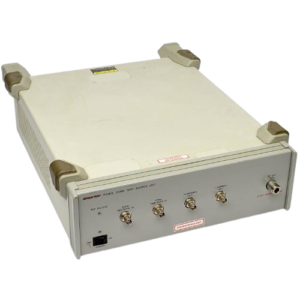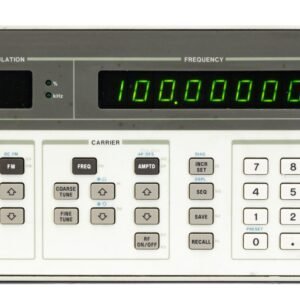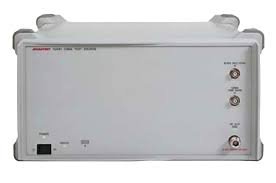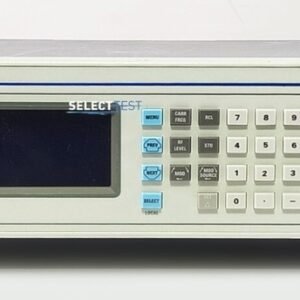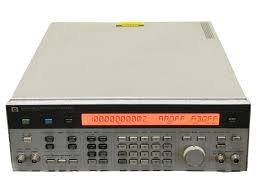
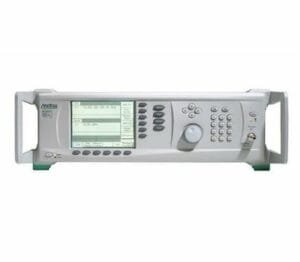

The Anritsu 68255B is a synthesized signal generator delivering precision RF signal generation across 0.5 to 26.5 GHz. Built for demanding test environments, it combines low phase noise, minimal harmonic distortion, and flexible modulation to support advanced R&D, production testing, and system integration tasks. With 1 Hz frequency resolution and output spanning -120 dBm to +13 dBm, the instrument meets exacting requirements for signal purity and measurement accuracy.
Technical Specifications
RF Performance
• Frequency range: 0.5 to 26.5 GHz
• Frequency resolution: 1 Hz
• Output power range: -120 dBm to +13 dBm (typical)
• Output level accuracy: ±0.5 dB typical
• Output impedance: 50 Ohms
Signal Purity
• Phase noise: <-100 dBc/Hz @ 10 kHz offset, <-110 dBc/Hz @ 100 kHz offset, <-125 dBc/Hz @ 1 MHz offset (all @ 10 GHz carrier)
• Harmonic distortion: <-40 dBc typical at +10 dBm output
• Spurious outputs: 70 dB on/off ratio, <10 ns minimum width, up to 10 MHz PRF
• Digital modulation (optional): QPSK, 8PSK, QAM (to 256-QAM), FSK
Sweep & Control
• Frequency sweep modes: List, Step, Logarithmic, Linear (adjustable sweep time)
• Power sweep modes: Step, Linear (adjustable sweep time)
• Remote control: GPIB (IEEE 488.2), Ethernet (LAN)
• SCPI command set supported
– Key Features
• 1 Hz resolution enables precise frequency setting across the entire band
• Phase noise performance supports sensitive receiver testing and system characterization
• Pulse generation with nanosecond timing resolution for radar and pulsed-RF applications
• Multi-format digital modulation for modern communication standards
• Programmable sweep functions accelerate automated test sequences
– Typical Applications
• Component and subsystem characterization in RF/microwave labs
• Production test of amplifiers, filters, and integrated RF circuits
• Receiver sensitivity and selectivity measurements
• Radar and pulsed-RF system development
• Modulation and demodulation validation
– Compatibility & Integration
Standard 19-inch rack configuration. GPIB and Ethernet control enable integration into automated test systems. 100–240 VAC, 50/60 Hz operation. Operating temperature: 0°C to 40°C.