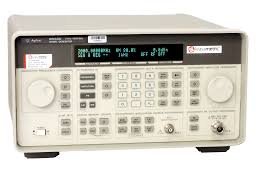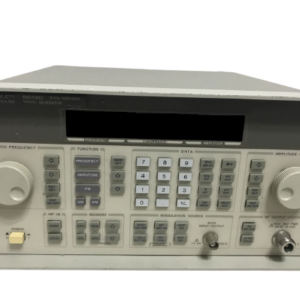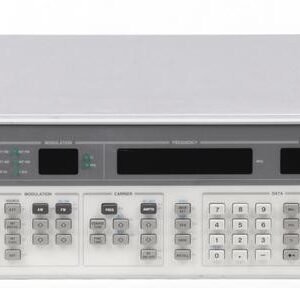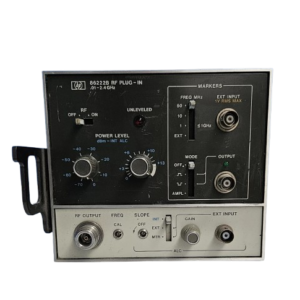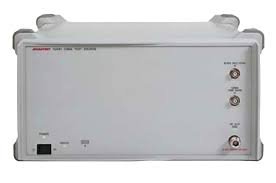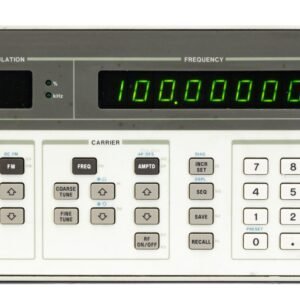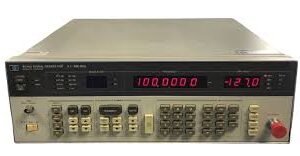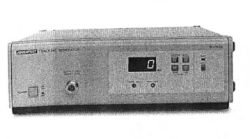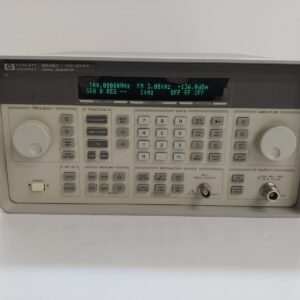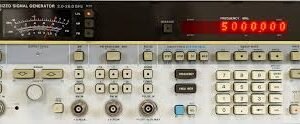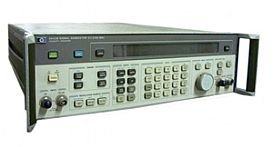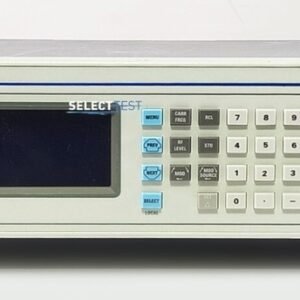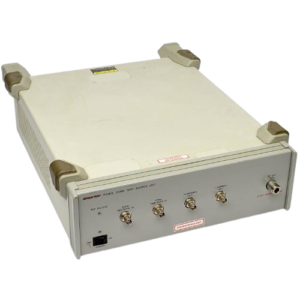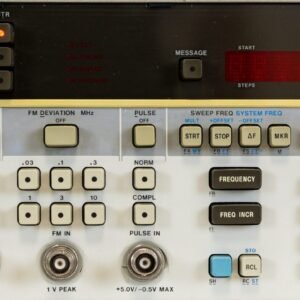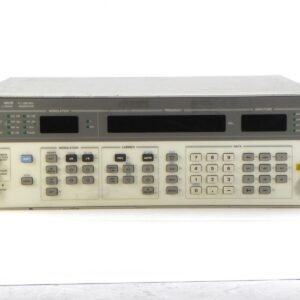
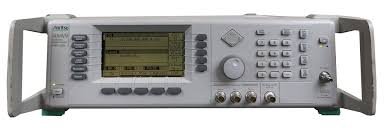

The Anritsu 69175A is a synthesized sweep generator delivering phase-locked RF and microwave signal generation across 0.5 to 50 GHz. Built for precision frequency control in laboratory, design validation, and production environments, it combines 1 kHz frequency resolution with flexible sweep modes—manual, analog, step, and alternate—enabling rapid characterization of components and systems across the full microwave band.
Technical Specifications
Frequency Range: 0.5 to 50 GHz
Frequency Resolution: 1 kHz standard; 0.1 Hz with Option 11
Frequency Accuracy: Dependent on 10 MHz time base. Aging: < 2 × 10⁻⁸/day (< 5 × 10⁻¹⁰/day with Option 16). Temperature stability: < 2 × 10⁻⁸/°C over 0 to 55 °C (< 2 × 10⁻¹⁰/°C with Option 16).
Output Impedance: 50 Ω
Power Flatness: Up to 1.6 dB (0.5–40 GHz) and 2.2 dB (40–50 GHz) for analog sweep; maximum variation 2.0 dB (0.5–20 GHz), 4.0 dB (20–40 GHz), and 5.0 dB (40–50 GHz).
Reference I/O: 10 MHz reference output (0.5 Vp-p into 50 Ω, AC coupled) and external 10 MHz reference input.
– Key Features
• Sweep Modes: Manual (< 8.5 ms/step switching), analog (1 MHz to full-range sweep, < 1 second sweep time), step sweep (1 to 10,000 steps, 1 kHz to full range step size, 1 ms to 99 seconds dwell), and alternate sweep between two ranges.
• Step Sweep Performance: Switching time typically < 15 ms + 1 ms/GHz or < 40 ms, whichever is less.
• Phase-Locked Operation: Enables precise frequency synthesis with sub-millisecond switching stability.
• Modulation: Internal AM, FM, and phase modulation capabilities.
• VNA Integration: Compatible with Wiltron 360B vector network analyzers; achieves < 8.5 ms/step phase-locked sweep speed under VNA control.
– Typical Applications
• Component characterization and S-parameter measurement
• RF/microwave system validation and design verification
• Production testing of amplifiers, filters, and integrated circuits
• EMC and RF immunity testing
– Compatibility & Integration
Front-panel and remote IEEE control interfaces enable standalone operation or integration into automated test systems. External 10 MHz reference input supports synchronization with external frequency standards.