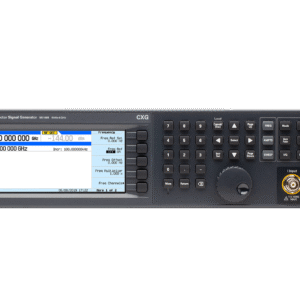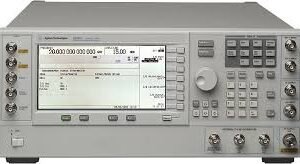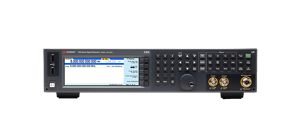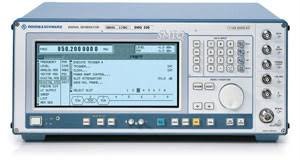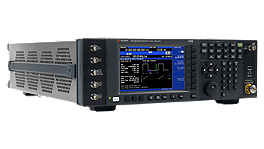
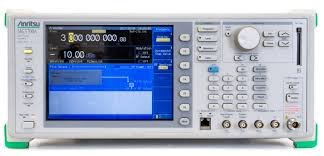

The Anritsu MG3700A is a vector signal generator delivering RF and wireless signal simulation across 250 kHz to 3 GHz, with optional extension to 6 GHz. Built around a 160 MHz sampling-rate arbitrary waveform generator, it produces complex modulation formats with high vector accuracy and phase noise of −125 dBc/Hz at 1 GHz. The instrument combines baseband generation (120 MHz modulation bandwidth internally; 150 MHz via external IQ input) with integrated BERT analysis up to 20 Mbps standard, making it suitable for R&D, manufacturing, and device validation in cellular, wireless LAN, and digital broadcast domains.
Technical Specifications
Frequency & Modulation
• Frequency range: 250 kHz to 3 GHz (standard); optional 6 GHz upper limit
• Modulation bandwidth: 120 MHz (internal); 150 MHz (external IQ)
• Frequency resolution: 0.01 Hz
• Phase noise: −125 dBc/Hz at 1 GHz
• Switching speed: 10 ms
Signal Generation
• Arbitrary waveform generator: 160 MHz sampling rate
• Waveform memory: 1 GB standard (256 Msamples/channel); 2 GB optional (512 Msamples/channel)
• Output power range: −140 dBm to +13 dBm
• Maximum output power: +10 dBm
• Absolute level accuracy: ±0.5 dB; linearity ±0.2 dB (typical)
Analysis & Storage
• Built-in BERT: 1 kbps to 20 Mbps (standard); 100 bps to 120 Mbps (optional)
• Hard disk: 40 GB
• Interface: 100BASE-TX Ethernet for high-speed waveform transmission
– Key Features
• IQproducer™ waveform generation software—PC-based tool for pattern creation across LTE/LTE-Advanced, WLAN, Mobile WiMAX, and other standards
• ASCII-to-waveform conversion from EDA tools (MATLAB, etc.)
• Supported standard patterns: W-CDMA/HSDPA, GSM/EDGE, CDMA2000 1X/1xEV-DO, IEEE 802.11a/b/g, PDC, PHS, Bluetooth®, GPS, ISDB-T/BS/CS/CATV digital broadcast, and AWGN
• Optional patterns: TD-SCDMA, Public Radio Systems (RCR STD-39, ARIB variants), DFS radar, ISDB-Tmm
– Typical Applications
Digital mobile communication system development and test; cellular device validation; wireless LAN equipment qualification; digital broadcast signal simulation.
– Physical
Benchtop form factor.