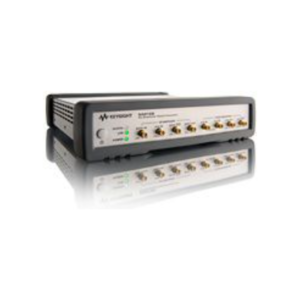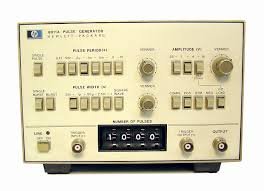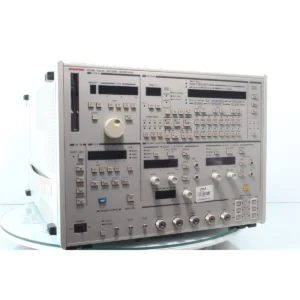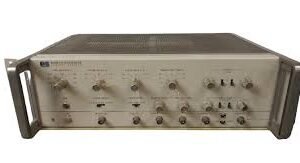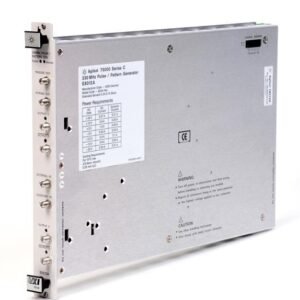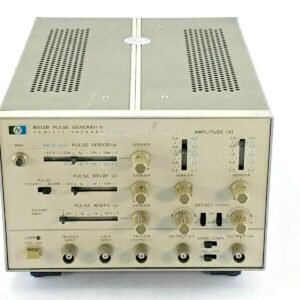
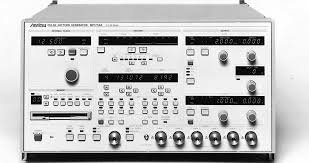

The Anritsu MP1758A Pulse Pattern Generator is a compact instrument for high-speed digital system testing and telecommunications applications. It generates programmable and pseudo-random binary sequence (PRBS) patterns across four independently adjustable data output channels and two clock output channels, operating from 0.1 GHz to 12.5 GHz with internal or external clock sources.
Technical Specifications
Output Architecture
• 4 data output channels (CH 1–4) with NRZ waveform
• 2 clock output channels (CLOCK 1–2)
• Frequency range: 0.1 GHz to 12.5 GHz
Clock Sources
• Internal clock with 1 kHz or 1 MHz resolution; 10 MHz reference (internal or external selectable)
• External clock input: 0.8 to 2.0 Vp-p sine wave (≥500 MHz) or square wave via APC-3.5 connector
Pattern Generation
• Programmable patterns: up to 128 kbit per channel (1, 2, or 4 channel modes)
• PRBS patterns: 7 types with periods from 2^7–1 to 2^31–1 bits; ¼ phase difference between channels supported
• Error insertion: rates selectable from 10^-4 to 10^-9; single error insertion capability
• Logic inversion supported
Data & Clock Output Characteristics
• Amplitude: 0.5 to 2.0 Vp-p in 10 mV steps
• Offset voltage: −2.0 to +2.0 VOH in 5 mV steps
• Clock-to-data delay: −500 ps to +500 ps in 1 ps steps
• 50 Ω load impedance; ECL termination; APC-3.5 connectors
Control & Environment
• GPIB (IEEE488.2) and parallel interfaces
• Operating temperature: 15°C to 35°C
• Dimensions: 426 mm (W) × 221 mm (H) × 450 mm (D)
• Weight: ≤37 kg
– Key Features
• Four independent data channels with precision amplitude and offset control
• Dual clock outputs with picosecond-level timing adjustment
• Seven PRBS pattern types spanning 2^7–1 to 2^31–1 bit periods
• Programmable error insertion at controlled rates
• Selectable internal/external reference; flexible clock configuration
– Typical Applications
• 6G development
• Virtual and cloud testing environments
• Internet of Things (IoT) systems
• Automotive high-speed digital validation
– Compatibility & Integration
GPIB and parallel control interfaces enable integration into automated test systems and remote operation environments.