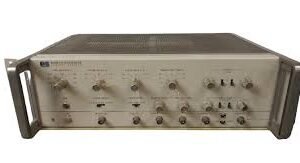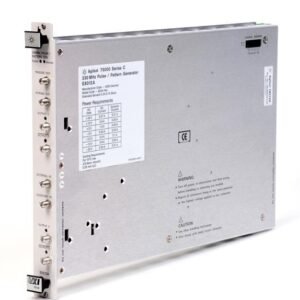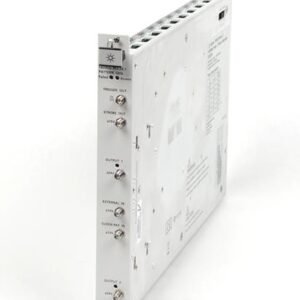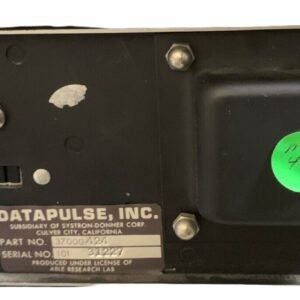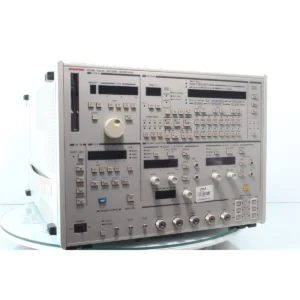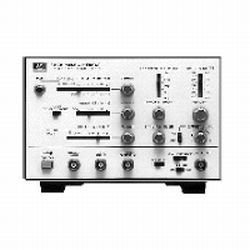
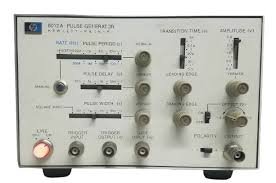

The HP/Agilent 8012A Pulse Generator delivers precise, programmable pulse generation across a wide frequency range, making it essential for circuit characterization, signal integrity testing, and time-domain analysis. Engineers rely on this instrument for its independent control of pulse width, rise/fall times, and repetition rate—all with exceptionally low jitter. The 8012A supports external triggering, synchronous gating, and cascade operation, enabling complex test sequences and multi-instrument synchronization.
## Technical Specifications
**Pulse Generation**
• Repetition Rate: 1 Hz to 50 MHz in four ranges with vernier adjustment
• Pulse Width: 75% from 1 Hz to 10 MHz; 40% at 50 MHz
• Period Jitter: <0.1% + 50 ps on any repetition rate
• Width Jitter: 30 ns): <5% maximum deviation (10–90% points)
• Overshoot/Ringing: <±5% of pulse amplitude
• Preshoot: 1.5 Vpp or pulses >0.8V, minimum 7 ns wide
• Trigger Output: >+1V across 50Ω; 16 ns ± 10 ns width
• Trigger Polarity Delay: 25 ns ± 8 ns
• Gate Input: DC-coupled; ~1600Ω impedance; TTL compatible; enables at >+1.5V or >3000Ω to ground
• External Triggering: 0 to 50 MHz repetition rate
• Synchronous Gating: Output pulses phase-aligned with gate leading edge
## Key Features
• Four independent ranges for repetition rate and pulse width with vernier fine-tuning
• Minimal jitter specification ensures signal fidelity in high-speed testing
• Asymmetrical rise/fall time control with 100:1 ratio capability
• TTL-compatible gate input for programmable pulse train control
• Trigger output suitable for cascading multiple 8012A units
• Independently adjustable DC offset across all amplitude settings
## Typical Applications
• Digital circuit testing and timing characterization
• High-speed pulse response measurement
• Device switching and transition analysis
• Multi-unit synchronization in test systems
• Pulse shaping and edge-rate studies
## Compatibility & Integration
The 8012A accepts both sinusoidal and TTL-level trigger signals, supports external gating for repeatable test sequences, and generates trigger outputs compatible with other 8012A units and standard test instruments. Gate input impedance and voltage thresholds follow TTL conventions, simplifying integration into automated test environments.