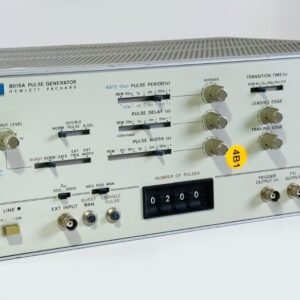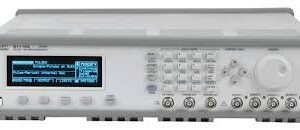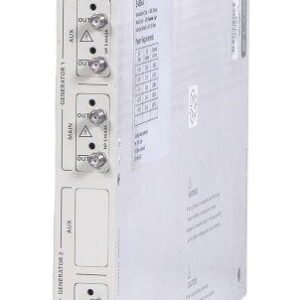
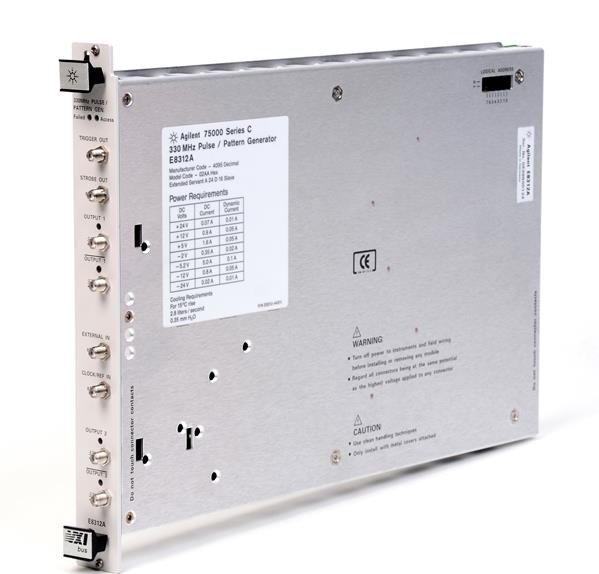

The Agilent/Keysight E8312A is a VXI C-size, 1-slot, register-based dual-channel pulse pattern generator delivering complex digital waveforms up to 330 MHz for digital systems testing and simulation. Each channel supports 16 Kbits of pattern memory, enabling sophisticated protocol emulation with pre-configured formats including RZ, NRZ, DNRZ, and PRBS. The instrument provides selectable transition times of 0.8 ns or 1.6 ns (10/90%), timing resolution to 5 ps, and pulse-width modulation capability with variable delay ranges for precise synchronization in automated test environments.
Technical Specifications
Frequency and Timing
• Maximum frequency: 330 MHz
• Timing resolution: 5 ps (best case, 3.5 digits)
• Transition times: Selectable 0.8 ns or 1.6 ns (10/90%)
• Period range: 3.03 ns to 999.5 s
• Pulse width range: 3.03 ns to (period – 3.03 ns)
• Delay range: 0 ns to (period – 3.03 ns)
• Frequency accuracy (with PLL): ±0.01%
• Width accuracy: ±0.5% ± 0.5 ns
Output Characteristics
• Output amplitude: 3.8 V into 50 Ω load
• Output impedance: 50 Ω
• Connectors: SMA (f) 3.5 mm, differential outputs
Module Specifications
• Type: VXI C-size, 1-slot, register-based
• Channels: Dual
• Pattern depth: 16 Kbits per channel
• Pattern formats: RZ, NRZ, DNRZ, PRBS
– Key Features
• Trigger modes: Continuous, external (triggered, gated, width), manual, internal (triggered with PLL or up-command)
• VXI backplane trigger connectivity (TTL lines 0-7 and ECL lines)
• Fixed and variable trigger-to-output delay for synchronization
• Clock distribution for test system synchronization
• Trigger and strobe output signals
– Typical Applications
• Digital circuit and component validation
• Complex protocol simulation and emulation
• Pulse-width modulated signal generation and testing
• Logic design verification with precise timing control
– Compatibility & Integration
Functionally compatible with Keysight 81100 and 8110A series pulse generators, enabling test routine portability from R&D to production. VXIplug&play software drivers included for direct integration into automated test systems.