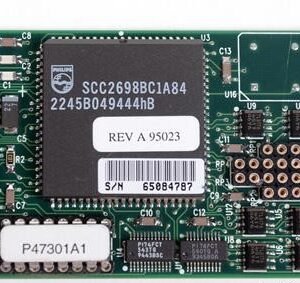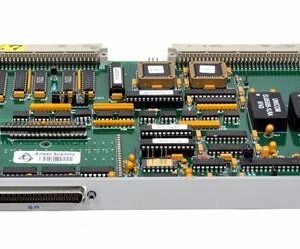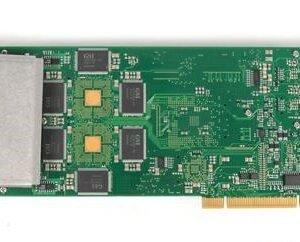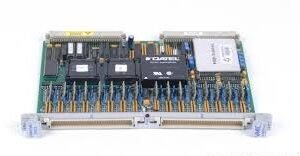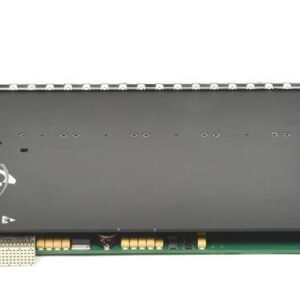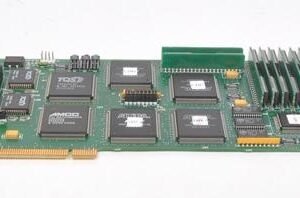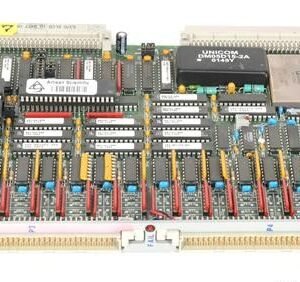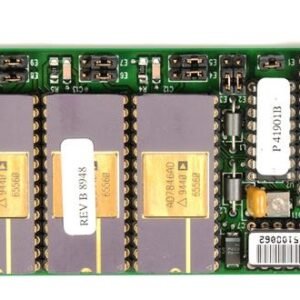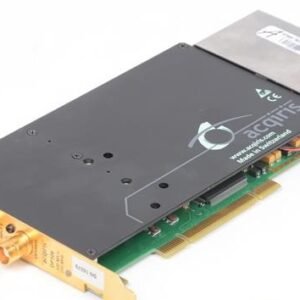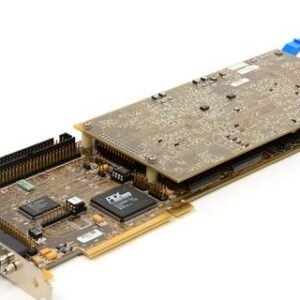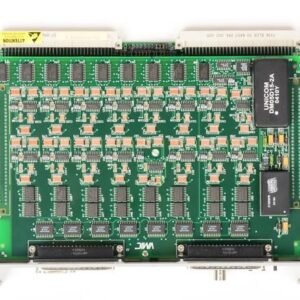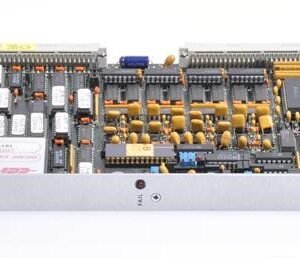
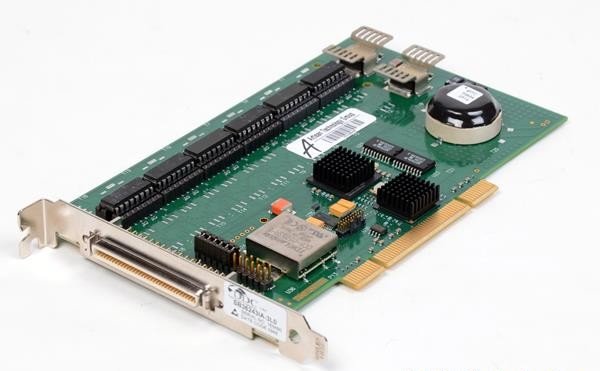

The DDC SB36243IA-3L0 is a half-size PCI card that converts synchro and resolver signals into high-resolution digital angle position data. Six independent channels, each equipped with a 16-bit RD-19230 monolithic converter, deliver 3 arc-minute accuracy (1 arc-minute for transformer-isolated variants) across input frequencies from 57 Hz to 7 kHz. The card interfaces electromechanical angle sensors directly to the PCI bus, supporting signal amplitudes up to 26 Vrms or 115 Vrms depending on the power oscillator configuration.
## Technical Specifications
• **Channels:** Six independent synchro/resolver-to-digital conversion channels
• **Converter:** DDC RD-19230 16-bit monolithic converter per channel
• **Accuracy:** 3 arc-minutes (standard); 1 arc-minute (transformer-isolated)
• **Jitter:** ±1 LSB at 47 Hz to 1 kHz
• **Input Frequency Range:** 57 Hz to 7 kHz
• **Input Signal Amplitude:** Up to 26 Vrms or 115 Vrms (oscillator-dependent)
• **Power Supply:** +5 Vdc, 0.665 A minimum (oscillator, no load)
• **Logic Output:** TTL compatible—Logic 0: 1.6 mA @ 0.4 V; Logic 1: 0.4 mA @ 2.8 V (10 TTL loads)
• **Form Factor:** Half-size PCI, 6.875 × 4.2 × 0.57 inches
• **Operating Temperature:** 0 to +71 °C or −40 to +85 °C
## Key Features
• Built-in synthesized reference eliminates phase-shift errors up to 45°
• Integrated turns counter tracks synchro/resolver rotations with direction information
• Incremental encoder output (A, B, Zero Index) per channel
• Self-test capability: injects 45° test angle; flags channels not reporting 45° ± 1°
• Built-in-test detects Loss-of-Signal, Loss-of-Tracking, and Loss-of-Reference faults
• Plug-and-play configuration via PC BIOS—no jumpers or switches required
• Supports shared interrupts for simplified installation
## Typical Applications
Radar, infrared and navigation systems, fire control, flight instrumentation and simulators, motor and motion feedback controls, robotics, machine tool control, antenna positioning, process control.
## Compatibility & Integration
PCI bus interface. Each channel operates independently, allowing mixed-signal processing across six simultaneous synchro or resolver inputs.