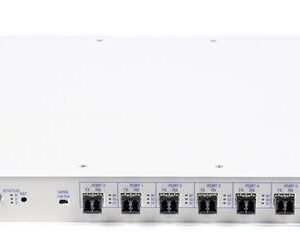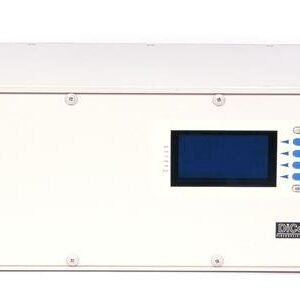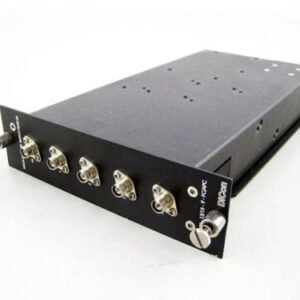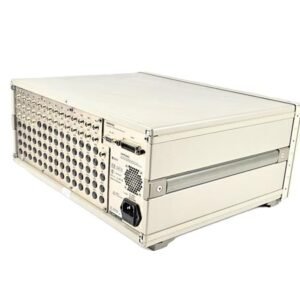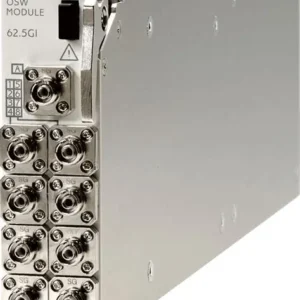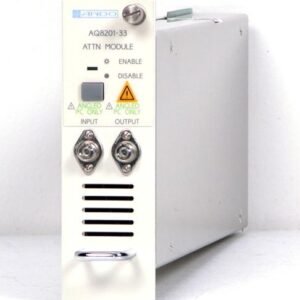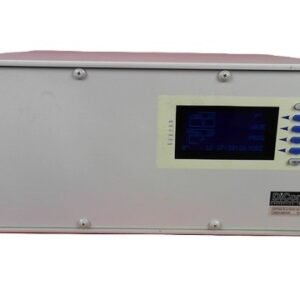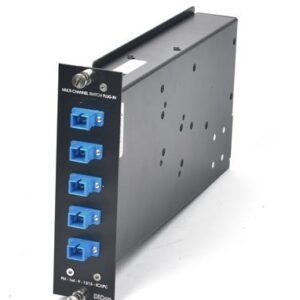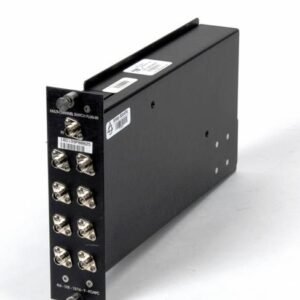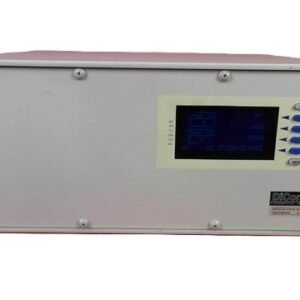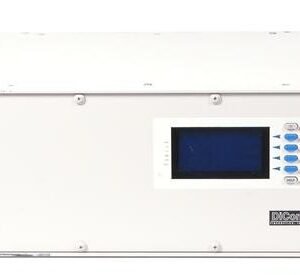

The DiCon GP700 Programmable Fiber Multi Switch (1×3) FC is a precision optical switching solution for test and measurement environments requiring dynamic fiber routing. This 1×3 switch delivers low insertion loss and exceptional repeatability across singlemode and multimode fiber types, with programmable control via RS-232 and IEEE 488.2 (GPIB) interfaces. The device supports automated testing sequences through mini-program functionality and nine memory registers for state management.
Technical Specifications
Optical Performance
• Insertion loss: 0.6 dB typical, 1.2 dB maximum (without connectors)
• Back reflection: −55 dB maximum (singlemode), −20 dB typical (multimode)
• Polarization dependent loss: 0.05 dB maximum (singlemode, 1550 nm)
• Cross-talk: −80 dB maximum
• Repeatability: ±0.02 dB maximum (100 sequential cycles at constant temperature)
• Switching time: 425 ms + 16 ms per channel maximum
• Mechanical durability: 10 million cycles minimum
Electrical Specifications
• Input voltage: 100 VAC to 240 VAC
• Input power: 150 W maximum
• Fuse rating: 2 A typical
• AC input leakage current: 3.5 mA maximum
• Logical high: 2 VDC to 5 VDC; logical low: 0 VDC to 0.5 VDC
• Continuous overload protection: ±30 VDC typical
• ESD protection: ±10 kV typical
Environmental
• Operating temperature: 0°C to +40°C
• Storage temperature: −20°C to +60°C
• Humidity: 40°C/90% RH/5 days
– Key Features
• FC connector interface for single-input, three-output routing
• Dual-wavelength operation: 1310 nm and 1550 nm (singlemode chassis); 800 nm and 1310 nm (multimode chassis)
• Programmable mini-programs for automated test sequences
• Nine memory registers for saving device configurations
• Available in rack-mountable (2U, 4U, 6U) or benchtop chassis
– Compatibility & Integration
Supports Corning SMF-28, Flexcor 1060, and polarization-maintaining Panda fiber. Control via standard laboratory interfaces (RS-232, GPIB) enables integration into existing automated test systems. Protocol-independent operation ensures compatibility across signal wavelengths, directions, and bandwidths.