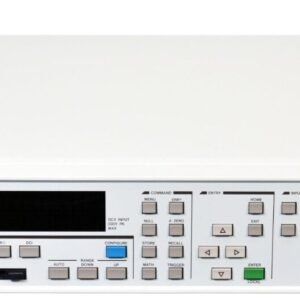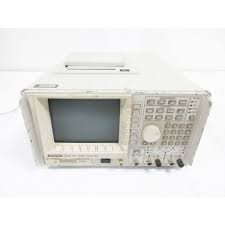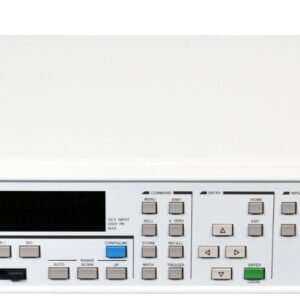
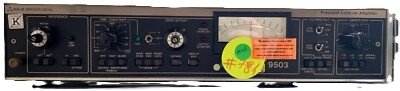

The EG&G Princeton 9503 Precision Lock-In Amplifier is a phase-sensitive detection instrument engineered to extract low-level signals from noise-dominated environments. It delivers high sensitivity down to nanovolts and provides calibrated phase adjustment for precise signal demodulation, making it essential for optical experiments, spectroscopy, and demanding scientific research requiring weak signal recovery.
Technical Specifications
Signal Detection and Processing
• Phase-sensitive detection (PSD) for magnitude and phase recovery of weak oscillating signals
• High dynamic reserve capability for handling significant interfering noise relative to signal level
• Full-scale sensitivity extending down to nanovolts
• Selectable signal channel filtering with low- and high-frequency rolloff modes
• Adjustable time constants for noise bandwidth and measurement settling time control
• Calibrated phase adjustment for precise demodulation
• DC output proportional to measured signal amplitude
Signal Input
• High input impedance with capacitive shunting to minimize loading
• Switch-selectable differential or single-ended input configuration
• Compatible with low-noise preamplifiers for enhanced signal acquisition
Reference Signal
• External reference input accepting synchronized signals
• Internal oscillator capability for reference generation
• Phase-locked loop (PLL) for locking internal reference to external signals with phase stability and tracking
Oscillator (Internal/Auxiliary)
• Generates sinusoidal signals with configurable frequency, amplitude, and voltage offset
• Adjustable frequency range for stimulus or reference generation
Interfaces and Control
• Computer control capability for remote operation and automation
• Standard output connectors for analog signals and digital data
Physical Form
• Benchtop instrument configuration for laboratory environments
– Key Features
• Phase-sensitive detection recovers signals buried in noise
• Multiple filtering and time constant selections optimize measurement conditions
• Differential and single-ended input flexibility accommodates various sensor types
• Integrated internal oscillator and PLL enable self-contained operation or external synchronization
• DC output simplifies integration with external recording and analysis systems
– Typical Applications
• Optical spectroscopy and photometric measurements
• Weak signal detection in research environments
• Phase-resolved signal analysis requiring high sensitivity
• Noise-suppressed measurements in scientific instrumentation
– Compatibility & Integration
The 9503 accepts low-noise preamplifiers for enhanced sensitivity at minimum signal levels and supports computer control for automated measurement sequences and remote operation.