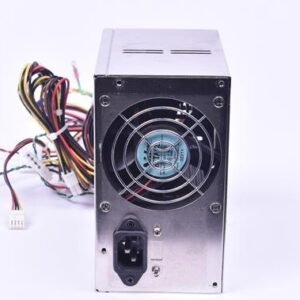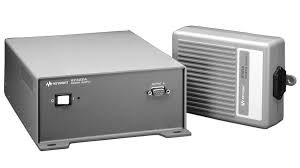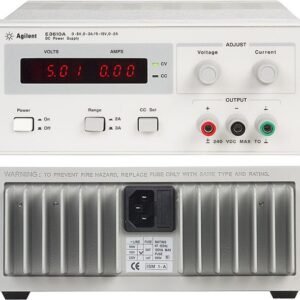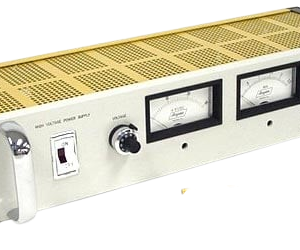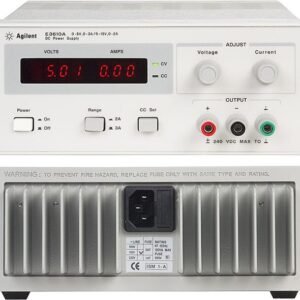
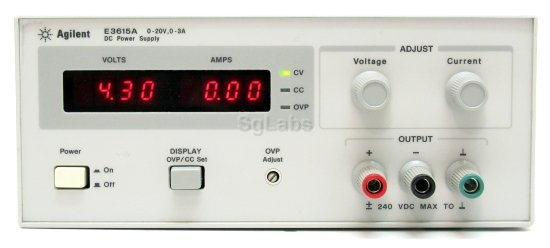

The HP/Agilent 3615A is a 60 W single-output DC power supply engineered for benchtop electronic testing, development, and system integration in laboratory environments. It delivers stable, adjustable DC voltage from 0 to 20 VDC at 0 to 3 A, with dual-mode operation in constant voltage and constant current. Manual control via 10-turn potentiometers combined with remote analog programming (0–10 V input) and local/remote sensing capabilities makes it suitable for precision applications requiring load-independent stability and dynamic transient response.
## Technical Specifications
• Output: 0–20 VDC, 0–3 A (60 W max)
• Voltage regulation (load & line): <0.01% + 2 mV
• Current regulation (load & line): <0.01% + 250 µA
• Ripple and noise (20 Hz–20 MHz): <200 µVrms / <1 mVpk-pk
• Transient recovery: <50 µsec to within 15 mV (full-to-half load change)
• Output drift (8 h post warm-up): <0.1% + 5 mV (voltage), <0.1% + 10 mA (current)
• Meter accuracy: ±0.5% + 2 counts (25 °C ±5 °C)
• Voltage resolution: 10 mV (0–20 V range)
• Current resolution: 10 mA
• Operating temperature: 0–40 °C (full output); derated 1%/°C from 40–55 °C
• Dimensions: 88.1 mm H × 212.3 mm W × 318.4 mm D
• Weight: 3.8 kg
## Key Features
• Adjustable current limiting and overvoltage protection safeguard devices under test
• Front and rear output terminals support multiple connection topologies
• Remote sensing compensates for lead-drop voltage losses in long cable runs
• Isolated outputs with 240 VDC float capability; either terminal can be grounded
• Programming linearity: 0.5% for both voltage and current channels
• Convection-cooled design requires no forced-air cooling infrastructure
## Typical Applications
Benchtop power conditioning for component characterization, power amplifier biasing, LED and optoelectronic device testing, system power distribution in development environments, and prototype validation where stable, programmable voltage and current sources are essential.
## Compatibility & Integration
The 3615A integrates with systems requiring 0–10 V analog control inputs and supports floating output configurations for multi-supply topologies. Local meter displays support manual operation; remote sensing terminals enable voltage regulation at the load terminals, not the supply.