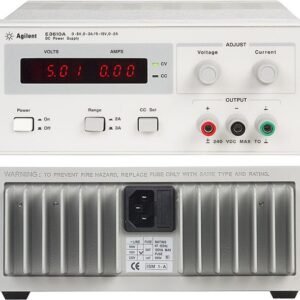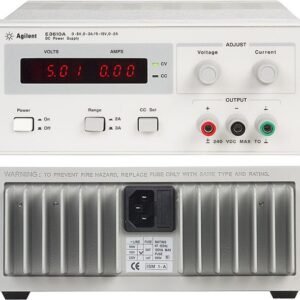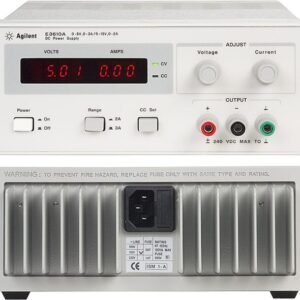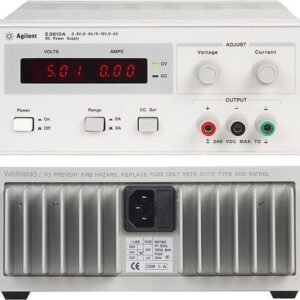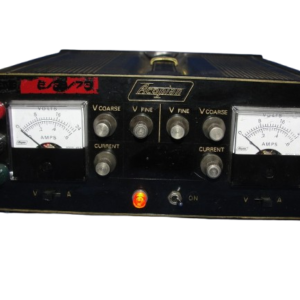
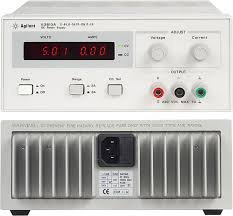

The HP/Agilent 3616A is a 60 W DC power supply delivering adjustable voltage and current outputs across 0–35 V and 0–1.7 A respectively. Dual-mode operation supports both Constant Voltage (CV) and Constant Current (CC), with load and line regulation of 0.01% + 2 mV and output noise of 200 µV RMS across the 20 Hz to 20 MHz band. Ten-turn potentiometers enable precise manual adjustment, while remote analog programming and remote sensing—with automatic lead-drop compensation—support flexible bench and system integration. Adjustable front-panel overvoltage protection safeguards the device under test. The unit accommodates auto-parallel, auto-series, and auto-tracking configurations, making it suitable for multi-supply test setups. Front and rear output terminals provide connectivity options for both direct connection and remote operation. Current rating decreases 1% per °C between 40° and 55°C operating temperature.
## Technical Specifications
• **Power:** 60 W maximum
• **Voltage Output:** 0 to 35 V
• **Current Output:** 0 to 1.7 A
• **Load & Line Regulation:** 0.01% + 2 mV
• **Output Noise:** 200 µV RMS, 1 mV peak-to-peak (20 Hz to 20 MHz)
• **Control:** 10-turn potentiometers for voltage and current adjustment
• **Protection:** Adjustable overvoltage protection with front-panel monitoring
• **Temperature Derating:** 1% per °C between 40° and 55°C
## Key Features
• Constant Voltage and Constant Current output modes
• Remote analog programming capability
• Remote sensing with automatic voltage drop compensation across load leads
• Dual output terminals (front and rear)
• Auto-parallel, auto-series, and auto-tracking operation
• LED display
• Compact bench-top form factor
## Typical Applications
• Laboratory power sourcing for circuit development and validation
• Device characterization under programmable load conditions
• Multi-supply test configurations via parallel or series operation
• Production test environments requiring adjustable voltage and current limits
## Compatibility & Integration
Remote analog programming enables integration into automated test systems. Remote sensing eliminates measurement errors from lead resistance in extended cable runs. Multi-unit configurations support synchronized voltage/current tracking or independent parallel/series stacking.