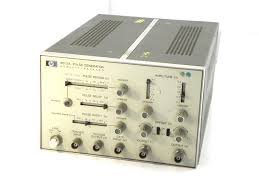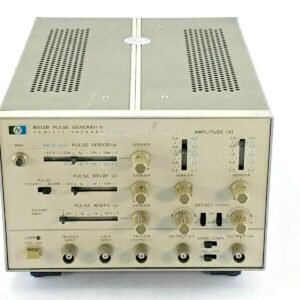
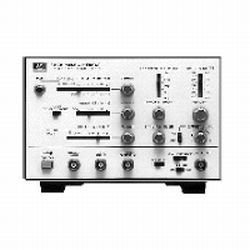

The HP/Agilent 8012B is a 50 MHz pulse generator engineered for digital circuit characterization and test stimulus applications. It delivers precise, low-noise pulses with fast edges across a wide range of parameters, from 1 Hz repetition rates to sub-nanosecond transition times. The instrument features dual switchable output impedances, multiple operating modes including external triggering and gating, and front-panel controls optimized for rapid setup and validation of digital logic circuits and integrated circuits.
## Technical Specifications
**Pulse Parameters**
• Repetition Rate: 1 Hz to 50 MHz
• Pulse Width: 10 ns to 1 s
• Pulse Delay: 35 ns to 1 s
• Rise/Fall Time (variable): 5 ns to 0.5 s; (fixed): down to 3.5 ns
• Jitter: <0.1% of programmed value + 50 ps
• Maximum Duty Cycle: 75% up to 10 MHz
**Output Specifications**
• Amplitude (50 Ω load): 0.2 V to 5 V
• Amplitude (high impedance load): 0.2 V to 10 V
• Maximum Output: 16 V total
• Offset: ±2.5 V (50 Ω source only)
• Source Impedance: Switchable 50 Ω / High Z
• Overshoot/Ringing: ±5% of amplitude; +10% (high impedance)
• Preshoot: 5% of amplitude
• Output Channels: Up to 2 selectable
## Key Features
• External triggering with 7 ns minimum signal width; selectable on positive or negative transition
• Gate mode for synchronous output control via external edge detection
• Operating modes: Normal, External trigger, Gate, Double Pulse, Square Wave, External Width, RZ
• SYM/NORM/COMPL output format selection
• Compact form factor: 142 mm H × 200 mm W × 330 mm D; 4 kg net weight
• Universal AC supply: 100/120/220/240 Vrms (±10%/-15%), 48–440 Hz, 70 VA maximum
• Operating temperature: 0°C to 55°C
## Typical Applications
Suitable for stimulus-response testing with digital oscilloscopes, circuit characterization, and board-level validation across multiple logic families.
## Compatibility & Integration
Supports RTL, DTL, TTL, selected ECL, and MOS logic families. Interfaces include trigger inputs, gate inputs, trigger outputs, and format selection connectors for integration into automated test systems.