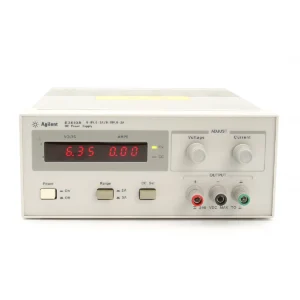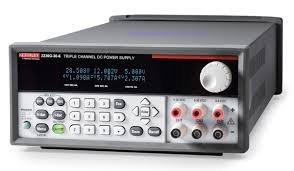

The Keithley 2230-30-6 is a three-channel programmable DC power supply delivering 375 W total power across independently controlled, galvanically isolated outputs. Two channels supply up to 30 V DC at 6 A each; the third provides 5 V DC at 3 A. Linear regulation ensures sub-1 mV rms ripple and noise, protecting sensitive circuits from supply-induced disturbances. Voltage and current resolution reach 1 mV and 1 mA respectively, with basic accuracy of 0.03% for voltage and 0.1% for current.
## Technical Specifications
• **Output Configuration:** Three independent channels with galvanically isolated outputs
• **Channel 1 & 2:** 0–30 V DC, 0–6 A per channel
• **Channel 3:** 0–5 V DC, 0–3 A
• **Total Power:** 375 W
• **Voltage Resolution:** 1 mV
• **Current Resolution:** 1 mA
• **Voltage Accuracy:** ±0.03% (basic)
• **Current Accuracy:** ±0.1% (basic)
• **Ripple and Noise:** < 1 mV rms
• **Remote Sensing:** All channels equipped
• **Output Protection:** Programmable OVP and overtemperature protection per channel
• **Dimensions:** 481.1 mm × 225.3 mm × 104.2 mm (2U, half-rack)
• **Weight:** 11.1 kg
## Key Features
• Each channel independently controlled with on/off switching
• Series mode: Combine two 30 V channels for up to 60 V output
• Parallel mode: Combine channels for current addition (up to 12 A from two 30 V channels)
• 30 memory locations store complete supply configurations
• Per-channel output timers for automated sequencing
• Front panel numerical keypad with key lock function
• Simultaneous voltage and current display across all channels
• Rectangular output characteristic enables full current delivery at maximum voltage
## Typical Applications
• Multi-rail circuit characterization and validation
• Sensitive analog and RF device testing
• Manufacturing test stations requiring isolated supplies
• R&D prototyping with flexible voltage/current combinations
## Compatibility & Integration
• USB and RS-232 interfaces standard
• GPIB support available via external adapter or specific models
• Programmable output limits enable fault containment