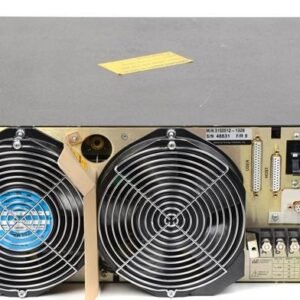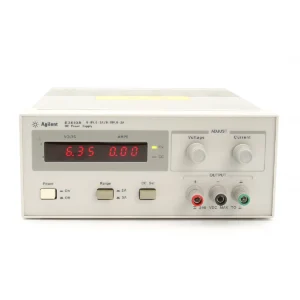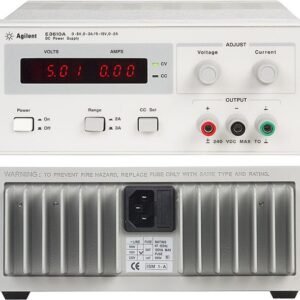
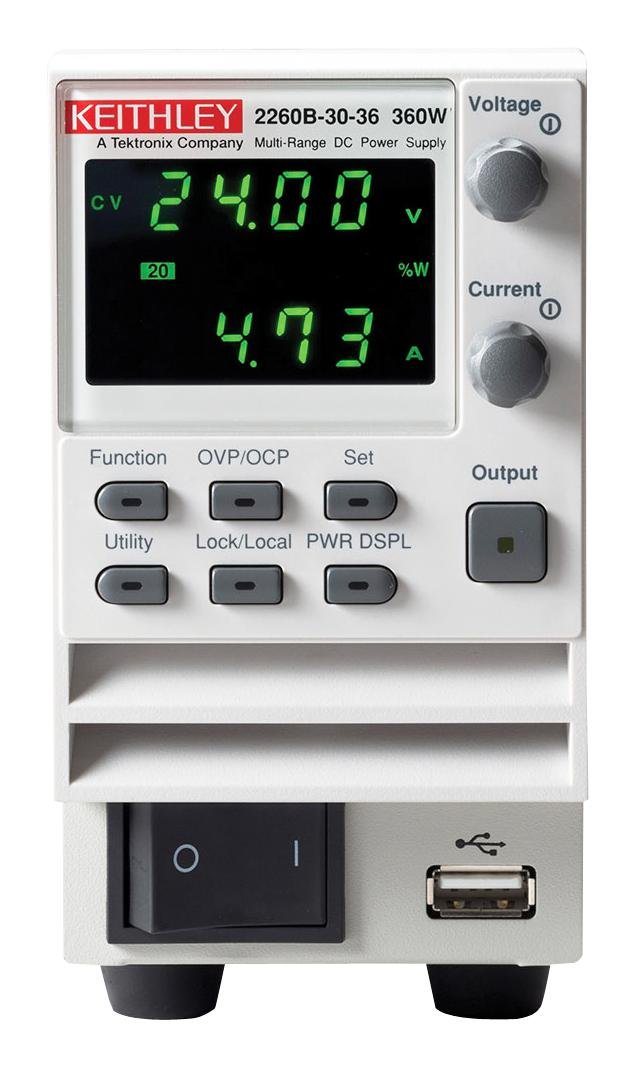

The Keithley 2260B-30-36 is a programmable DC power supply delivering up to 30V and 36A with 360W maximum output power. It provides precise voltage and current control with programmable rise and fall times, protecting low-impedance loads from inrush current damage and eliminating overshoot in LED applications. The unit simulates battery characteristics through programmable internal resistance and supports constant current priority mode to minimize transient overshoot.
Technical Specifications
Output Characteristics:
• Single output channel: 0V to 30V, 0A to 36A (360W maximum)
• Output power derating: V × A cannot exceed 360W
• Programmable internal resistance for battery simulation
• Constant current priority setting for LED and sensitive loads
• Output resistance programming supported
• Internal test sequence mode with stored, repeatable sequences
• Series or parallel configuration capability
Constant Voltage Mode Performance (typical, 23°C ± 5°C, after 30-minute warmup):
• Line regulation: 18 mV (85–132 VAC or 170–265 VAC input)
• Load regulation: 20 mV (no load to full load)
• Ripple and noise: 60 mV peak-to-peak (10 Hz to 20 MHz), 7 mV RMS (5 Hz to 1 MHz)
• Temperature coefficient: 100 ppm/°C of rated output voltage
• Remote sense compensation: 0.6V
• Rise time: 50 ms (rated and no-load conditions)
• Fall time: 50 ms (rated load), 500 ms (no load)
• Transient recovery: 1 ms to within 0.1% + 10 mV for 50% to 100% load step
Protection:
• Overvoltage protection: 3V to 33V range, ±2% of rated output accuracy
• Overcurrent protection: 3.6A to 39.60A range, ±2% of rated output accuracy
• Overtemperature protection included
– Key Features
• Programmable rise and fall times prevent inrush current damage and control overshoot
• Constant current priority mode optimized for LED applications
• Battery characteristic simulation via programmable internal resistance
• USB and LAN connectivity standard; optional GPIB interface
• Rack-mount design for integrated test environments
– Typical Applications
• LED and photonic device testing
• Battery simulation and characterization
• Low-impedance load powering with controlled transient response
• Automated test sequences at multiple voltage levels
– Compatibility & Integration
Standard USB and LAN interfaces enable integration into automated test systems. Optional GPIB interface supports legacy equipment configurations. Dual-unit series or parallel connection expands voltage or current capability.