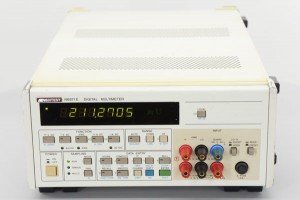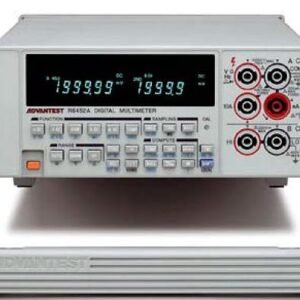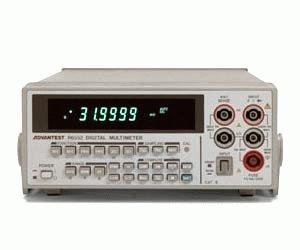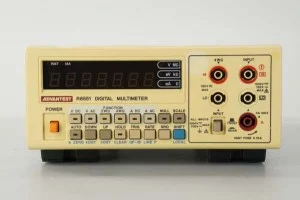
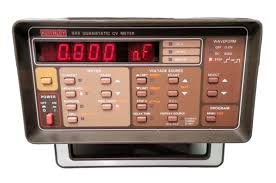

The Keithley 595 Quasistatic CV Meter is a specialized instrument for precise capacitance-voltage (C-V) characterization of Metal Insulator Semiconductor (MIS) devices and materials. It employs the quasistatic “feedback charge” method with integrated diagnostics and error corrections, delivering high-confidence measurements of semiconductor electrical properties. The instrument combines a programmable voltage source with a sensitive picoammeter, enabling comprehensive C-V and I-V analysis across wide dynamic ranges.
Technical Specifications
Capacitance Measurement
• Measurement Range: 10 fF to 20 nF
• Resolution: 0.01 fF to 0.01 pF (range-dependent)
• Accuracy (1 Year, 18–28°C): ±(0.25% reading + 2 mV) for analog output
• Leakage Current Correction: Included
• Digital Filtering: Three non-recursive filters to reduce noise without curve distortion
• Normalization: CO-referenced readings for gain error correction and device comparison
Current Measurement
• Range: 1 fA to 200 µA
• Resolution: 0.01 fA to 0.01 nA per count (range, STEP V, and DELAY TIME dependent)
• Accuracy (1 Year, 18–28°C): ±(1.0% reading + 2 counts), exclusive of input bias current and noise
Voltage Source
• Output Range: −20.00 V to +20.00 V
• Increment: 0.01 V
• Accuracy (1 Year, 18–28°C): ±(0.2% + 10 mV)
• Maximum Output Current: ±2 mA; active current limit <4 mA
• Settling Time: <3 ms to rated accuracy
• Noise: <(1 ppm output voltage + 100 µV) p-p, 0.1–10 Hz
• Waveforms: DC, staircase (STEP), and squarewave
• Step Voltage: 0.01 V, 0.02 V, 0.05 V, or 0.10 V (±2%), selectable polarity
• Delay Time: 0.07 s to 199.99 s in 0.01 s increments (±0.05%)
• Maximum Input Voltage: 30 V peak, DC to 60 Hz sine wave
– Key Features
• Feedback charge method with built-in error diagnostics and corrections
• Suppress function for relative C, C/CO, and I measurements
• Wide capacitance range with femtofarad-level resolution
• Picoammeter sensitivity spanning six decades
• Multiple voltage waveform modes for diverse characterization protocols
– Typical Applications
• MIS device and material characterization
• Semiconductor interface quality assessment
• Oxide thickness and trap density analysis
• Device-to-device capacitance comparison via normalization