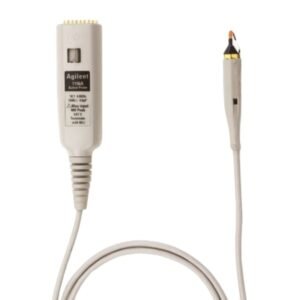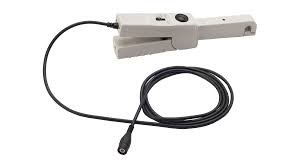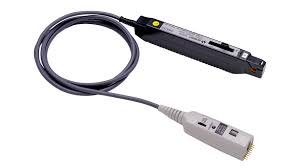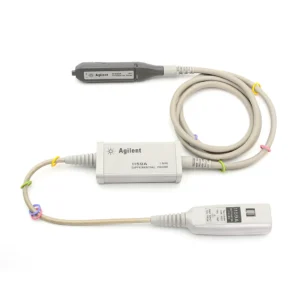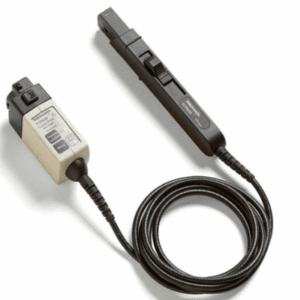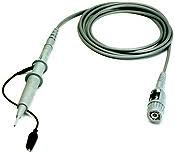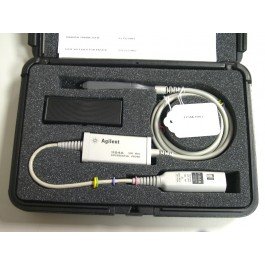

The Agilent/Keysight 1154A is a wide-band differential active probe engineered for precision signal acquisition in demanding test environments. FET-buffered inputs in the probe head deliver high common-mode rejection and minimal circuit loading. The probe features selectable attenuation (1:1 and 10:1), user-selectable offset, and DC/AC input coupling capability, making it suitable for characterizing low-level differential signals across multiple gain configurations.
Technical Specifications
Bandwidth: DC to 500 MHz (-3 dB, probe only)
Rise Time:
• 700 ps (10:1 attenuation)
• 875 ps (1:1 attenuation)
Input Impedance: 1 MΩ (each side to ground)
Input Capacitance:
• 1.6 pF (between inputs, 10:1 attenuation)
• 3.1 pF (between inputs, 1:1 attenuation)
• 3 pF (each side to ground, 10:1 attenuation)
• 6 pF (each side to ground, 1:1 attenuation)
Common Mode Rejection Ratio (Unity Probe Gain):
• 80 dB @ 70 Hz
• 80 dB @ 100 kHz
• 60 dB @ 1 MHz
• 40 dB @ 10 MHz
• 14 dB @ 250 MHz
Gain Settings: X1, X10, X100 (with external attenuator)
LF Gain Accuracy: ±2% into 50 Ω load, measured at 1 kHz (X1, X10)
Output Impedance: 50 Ω nominal
Noise (5–1000 MHz):
• 6 nV/√Hz (1:1 attenuation, 10X gain)
• 10 nV/√Hz (1:1 attenuation, 1X gain)
• 60 nV/√Hz (10:1 attenuation, 10X gain)
• 115 nV/√Hz (10:1 attenuation, 1X gain)
Maximum Input Voltage:
• ±42 V single-ended (10:1 attenuation)
• ±4.2 V single-ended (1:1 attenuation)
• ±40 V differential (1X gain, 10:1 attenuation)
• ±4 V differential (10X gain, 10:1 attenuation)
• ±400 mV differential (1X gain, 1:1 attenuation)
• ±40 mV differential (10X gain, 1:1 attenuation)
Input Coupling: DC / AC (AC coupling via optional adapter)
– Key Features
• Low input capacitance minimizes circuit loading and disturbance
• Selectable attenuation accommodates signals from millivolts to tens of volts
• FET buffering enables high input impedance with low noise performance
• User-adjustable offset for optimized display and measurement range
• 50 Ω output impedance for direct integration with standard test equipment
– Typical Applications
• Differential signal characterization in high-speed digital circuits
• Low-noise analog measurement in precision instrumentation
• Power supply and regulator output monitoring
• Transient and noise analysis in mixed-signal designs