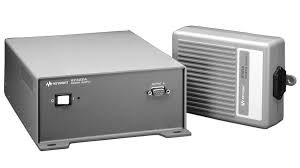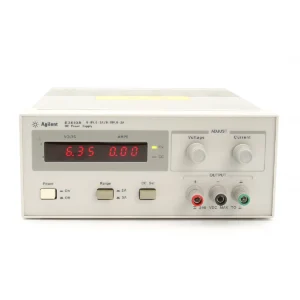
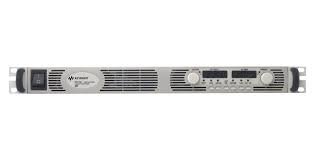

The Keysight N5764A is a programmable DC power supply engineered for automated test systems and high-current applications requiring stable, precision power delivery. This single-output unit delivers up to 1520 W across a 0–20 V, 0–76 A operating range, housed in a compact 1U rack-mountable package. Universal AC input (85–265 VAC, 47–63 Hz) with 0.99 power factor correction ensures efficient operation across global line conditions. Output ripple and noise measure 60 mVpp, with measurement accuracy of ±40 mV and programming accuracy of ±20 mV. The supply operates in both constant voltage and constant current modes, with response time of 80 ms and command processing time of 55 ms. Load regulation is tight: 17 mV voltage deviation and 5.26 mA current deviation across 10–90% load swings.
Technical Specifications
• Output: 0–20 V, 0–76 A, 1520 W maximum, single output
• Input: Universal AC 85–265 VAC, 47–63 Hz; 21 A @ 100 VAC, 11 A @ 200 VAC
• Output Quality: 60 mVpp ripple and noise; ±40 mV measurement accuracy; ±20 mV programming accuracy
• Load Regulation: ±17 mV (voltage), ±5.26 mA (current) for 10–90% load change
• Response & Control: 80 ms output response; 55 ms command processing; CV/CC operation
• Protection: Over-voltage, over-current, over-temperature, and under-voltage limit (UVL)
• Remote Sense: Yes
– Key Features
• LXI Class C compliance with integrated web server for browser-based remote access
• Multiple standard interfaces: GPIB, LAN, USB
• Analog programming via 0–5 V or 0–10 V voltage control, or 0–5 kΩ or 0–10 kΩ resistance
• 15 programmable store/recall states
• Front panel rotary encoders with optional front panel lock
• Independent remote on/off and enable/disable control
– Physical Characteristics
• 1U high, 19-inch wide rack-mountable form factor
• Ventilation ports on front, sides, and rear for stacking compatibility
– Typical Applications
• Production test of high-current devices and modules
• Automated semiconductor and power electronics characterization
• Battery charging and discharge simulation
• Burn-in and reliability testing of power-sensitive components