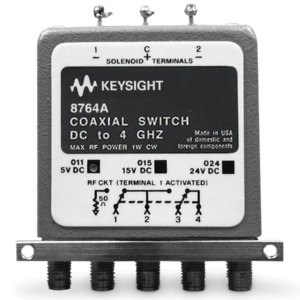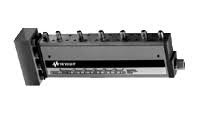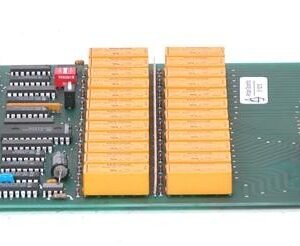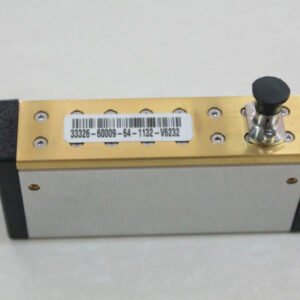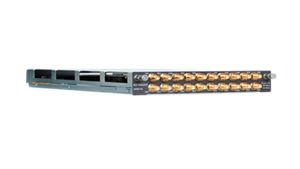
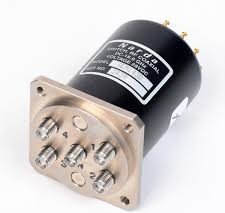

The L-3/Narda/Miteq SEM143D is a Single Pole 4-Throw (SP4T) electro-mechanical RF switch engineered for DC to 18 GHz operation. This stocked component delivers TTL logic control with integrated indicator circuitry for real-time RF status monitoring and suppression diodes for transient voltage protection. Built to MIL-S-3928 standards, it handles one to two million switching cycles per position without performance degradation, making it suitable for both military and commercial RF switching applications.
## Technical Specifications
**Frequency Performance**
• DC–3 GHz: 0.2 dB max insertion loss, 1.2:1 max VSWR, 80 dB min isolation
• 3–8 GHz: 0.3 dB max insertion loss, 1.3:1 max VSWR, 70 dB min isolation
• 8–12.4 GHz: 0.4 dB max insertion loss, 1.4:1 max VSWR, 60 dB min isolation
• 12.4–18 GHz: 0.5 dB max insertion loss, 1.5:1 max VSWR, 60 dB min isolation
• RF Impedance: 50 Ω nominal
**Control & Power**
• Actuating Voltage: 28 Vdc
• Actuating Current: 140 mA @ 28 Vdc, 25 °C
• TTL Logic Input: Low (0–0.8 Vdc), High (2.5–5.0 Vdc)
• TTL Input Current: 1.6 mA max @ 3.85 Vdc (high state)
• Switching Speed: 15 ms typical
**Power Handling & Linearity**
• Full Performance: 20 dBm
• No-Damage Rating: 30 dBm
• Third Order Input Intercept Point: 35 dBm typical
**Environment**
• Operating Temperature: −35 to 70 °C
## Key Features
• Single Pole 4-Throw configuration for multi-channel RF routing
• TTL-compatible logic control requiring no additional voltage supply
• Indicator circuitry for external RF status monitoring
• Built-in suppression diodes protect against coil transient voltages
• Optional terminated units with 50 Ω internal loads (1 W CW max) on unused ports
• Normally open architecture until actuated
• SMA female connectors standard
## Typical Applications
• Multi-channel RF test and measurement systems
• Military and commercial RF switching networks
• Broadband signal routing from DC through microwave frequencies
• Systems requiring reliable electro-mechanical switching with high cycle life
## Compatibility & Integration
Standard SMA female connectors support direct integration into 50 Ω RF systems. TTL logic interface enables straightforward integration with digital control architectures without additional voltage conditioning.