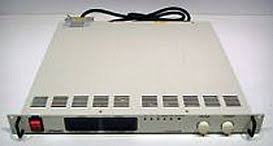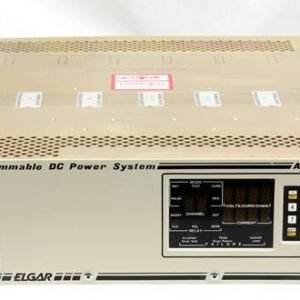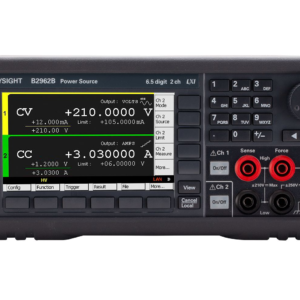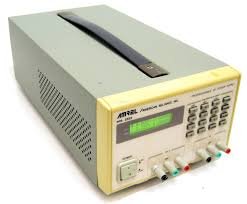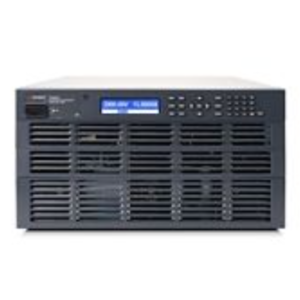
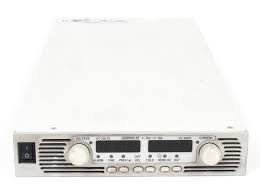

The TDK-Lambda GENH 20-38 is a 760 W programmable DC power supply engineered for OEM, industrial, and laboratory applications. It delivers continuously adjustable output from 0 to 20 VDC at 0 to 38 A in a compact 1U half-rack form factor. Single-phase AC input spans 85 to 265 VAC (47 to 63 Hz) with active power factor correction at 0.99 typical at full load, meeting European EMC requirements for stable operation across variable power environments.
## Technical Specifications
**Input Power**
• Single-phase AC input: 85 to 265 VAC
• Input frequency: 47 to 63 Hz
• Active Power Factor Correction (PFC): 0.99 typical at full load
**Output Characteristics**
• Voltage range: 0 to 20 VDC
• Current range: 0 to 38 A
• Rated output power: 760 W
• Efficiency: 85% typical
• Voltage ripple noise: 0.008 Vrms (5 Hz to 1 MHz)
• Current ripple noise: 0.076 Arms (5 Hz to 1 MHz)
• Operating modes: Constant Voltage (CV) / Constant Current (CC) with automatic crossover
**Control & Interfaces**
• Standard: RS-232, RS-485
• Optional: LAN (LXI compliant), GPIB (IEEE 488.2), USB, isolated analog voltage control (0–5 V or 0–10 V), isolated analog current control (4–20 mA)
• Front panel: Rotary encoders (6 or 30 turns), four-digit LED meters
• Digital resolution: 16-bit A/D and D/A converters
• Serial configuration: 1200 to 19200 baud; 31 addressable nodes
## Key Features
• Adjustable Over Voltage Protection (OVP), Under Voltage Limit (UVL), and Current Foldback with latch mode option
• Safe Re-Start: Selectable return to previous settings or zero output after power loss
• Non-volatile memory retention of voltage, current, mode, OVP, UVL, foldback, baud rate, and start-up configuration
• Front panel lockable locally or via software
## Typical Applications
Automotive, semiconductor manufacturing, medical technology, and aerospace environments requiring precise, flexible power delivery with comprehensive protection.
## Compatibility & Integration
Supports RS-232/RS-485 global command protocols. LXI-compliant LAN option enables network integration. Analog control interfaces (0–5 V, 0–10 V, 4–20 mA) permit legacy and modern instrumentation integration.