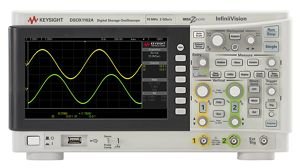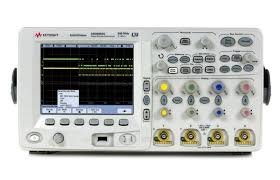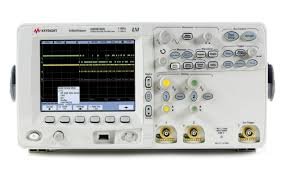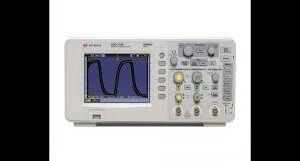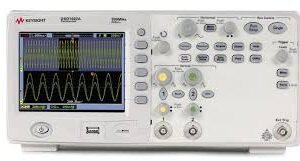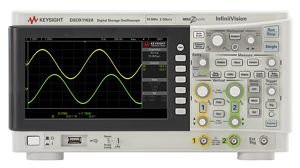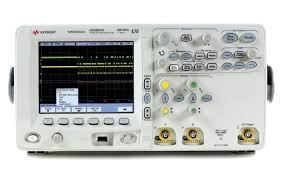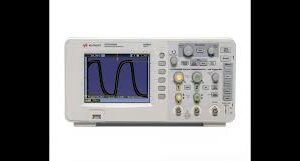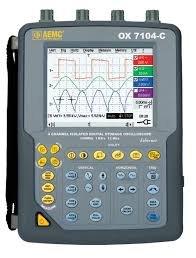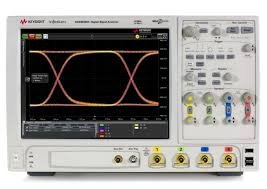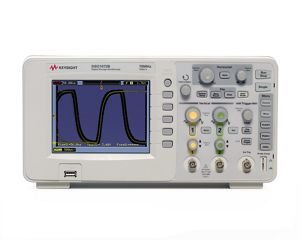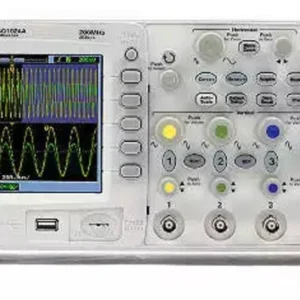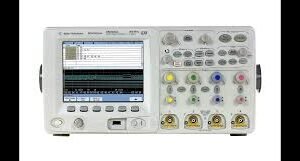

The LeCroy 352A is a 500 MHz, 2-channel digital oscilloscope engineered for high-speed signal acquisition, troubleshooting, and design validation. It delivers 1 GS/s single-channel or 2 GS/s interleaved sampling with 500 kpts/ch memory and up to 200 Mpts/ch record length, capturing up to 500,000 waveforms/s in sequence mode. The 750 ps rise time and 8-bit vertical resolution enable precise measurement of fast transients across a 2 mV/div to 10 V/div sensitivity range.
Technical Specifications
• Bandwidth: 500 MHz
• Channels: 2
• Sample Rate: 1 GS/s (single-channel), 2 GS/s (interleaved), 1 GS/s (all channels 2-ch mode)
• Memory: 500 kpts/ch; up to 200 Mpts/ch record length (interleaved)
• Rise Time: 750 ps
• Vertical Resolution: 8-bit
• Vertical Sensitivity: 2 mV/div to 10 V/div
• Vertical DC Gain Accuracy: ±(1.5% + 0.5% of full scale)
• Maximum Input Voltage: 400 V CAT I
• Input Impedance: 1 MΩ ±1.5% || 20 pF; 1 MΩ ±1.5% || 16 pF (50 Ω)
• Input Coupling: GND, DC 1 MΩ, AC 1 MΩ
• Bandwidth Limiting Filters: 20 MHz, 200 MHz
• Timebase Range: 500 ps/div to 50 s/div
• Timebase Accuracy: 10 ppm (typical)
• Display: 7.5″ Color TFT-LCD, 640 × 480 VGA
• Dimensions (HWD): 190 mm × 285 mm × 102 mm
• Weight: 3.2 kg
– Key Features
• Advanced Triggering: Edge, glitch, period, pulse width, pulse count, TV, slope, window, runt, interval, dropout, pattern, video, and zone triggers with low jitter
• Serial Protocol Support: Built-in IIC, SPI, UART, CAN, and LIN triggering and decoding
• Waveform Capture: 120,000 wfm/s (normal) or 500,000 wfm/s (sequence mode)
• Replay Mode: Review up to 1,024 consecutive waveforms to isolate anomalies
• Waveform Sequence Recorder: Stores and plays back up to 90,000 waveforms
• Measurement Suite: 20+ parameter measurements including rise time, fall time, duty cycle, frequency, and FFT (up to 8 kpts)
• Math Functions: Sum, difference, product, and FFT analysis
• QuickZoom: Dedicated button for rapid waveform magnification
• BNC Probing: Probe Sense Ring interface
– Typical Applications
Electronics testing, design validation, signal integrity analysis, serial bus debugging, and general-purpose bench troubleshooting.
– Connectivity & Integration
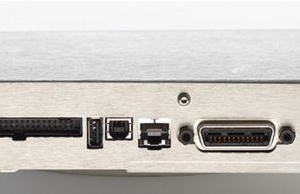
• USB: Host and device connections
• Optional Interfaces: GPIB and LAN for data transfer and remote control
• Supported Peripherals: Printers and external storage via USB