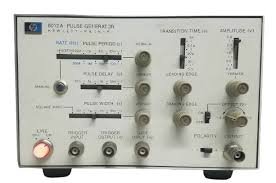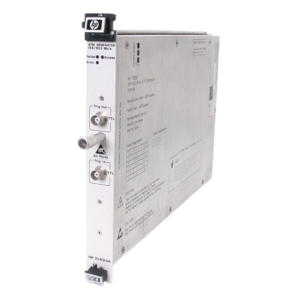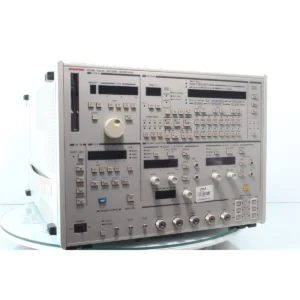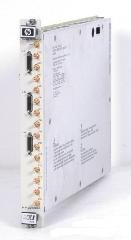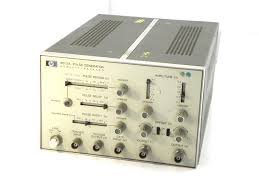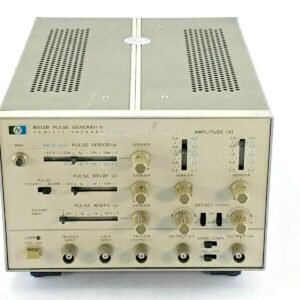

The Philips PM 5786B is a dual-channel pulse generator delivering precise pulse generation from 1 Hz to 125 MHz with continuously variable transition times from 2 ns to over 100 ms. Built for high-speed TTL and ECL circuit characterization, it provides jitter < 0.1% of setting ± 50 ps and minimum rise/fall times of 1.4 ns (20% to 80%) for ECL applications. The instrument supports single pulse, double pulse, square wave, and burst modes with 0 to 9999 selectable pulse counts, making it ideal for memory circuit, shift register, and counter validation. Dual outputs (A and B) operate in bipolar, positive, or negative polarity with normal or complementary switching. External triggering, gating, and duration-lock modes enable synchronous operation up to 125 MHz. Output amplitude ranges from 0.2 V to 5 V into 50 Ω load, with DC offset capability from -2.5 V to +2.5 V. Maximum output voltage is ±6 V with built-in protection against shorts, open circuits, and transients.
Technical Specifications
• Frequency Range: 1 Hz to 125 MHz
• Pulse Repetition Period: 8 ns to 1 s
• Pulse Delay: 8 ns to 100 ms
• Pulse Duration: 3.5 ns to 100 ms or fixed square wave
• Jitter: 100 ms continuously variable; 1.4 ns minimum for ECL (20% to 80%)
• Output Amplitude: 0.2 V to 5 V (50 Ω load); ±6 V maximum (open circuit)
• DC Offset: -2.5 V to +2.5 V (50 Ω load); ±5 V at open output
• Waveform Aberrations: < 5% + 10 mV (50 Ω); < 10% for transition times < 5 ns
• Source Impedance: 50 Ω ± 10%
• External Trigger Input: 0.5 V to 15 V pp; 1 MΩ || 25 pF impedance; ±3 V trigger level range
– Key Features
• Dual independent channels with bipolar, positive, and negative output modes
• Internal burst generation with 0 to 9999 pulse selection
• External triggering, gating, and duration-lock operating modes
• Square wave output 50% ± 1% (1 Hz to 1 MHz); 50% ± 10% (1 MHz to 125 MHz)
• Positive and negative trigger slope selection
– Typical Applications
Memory circuit testing, shift register validation, counter characterization, high-speed digital logic evaluation.