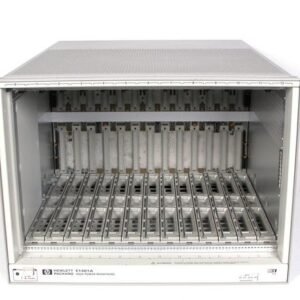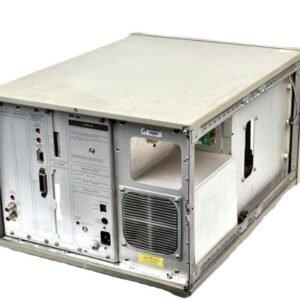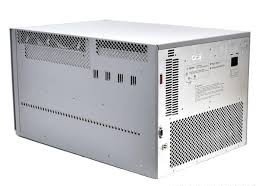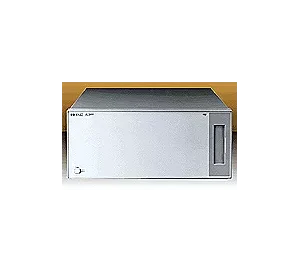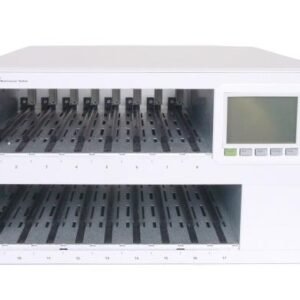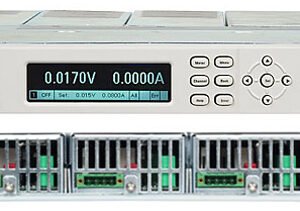

The Profile Pro8000-4 is an 8-slot modular mainframe chassis engineered for electro-optical test and control applications requiring high current capacity. This 19-inch rackmount unit delivers up to 32 A total output current across eight individually rated 4 A slots, with a maximum power consumption of 640 VA. The chassis features a menu-driven front panel interface with a 4 × 20 character vacuum-fluorescence display, enabling PC-independent operation and automatic module identification on power-up. Dual communication interfaces—IEEE 488.2 and RS232C—provide both local and remote control capabilities for integrated test systems.
Technical Specifications
• Chassis: 8-slot modular mainframe, 19-inch rackmount
• Current Rating: 4 A per slot; 32 A maximum total output
• Power Consumption: 640 VA maximum
• Input Power: 100 V, 115 V, or 230 V (±10%), 50/60 Hz fixed
• Operating Temperature: 0 °C to +40 °C
• Interfaces: IEEE 488.2 (GP-IB), RS232C
• Display: 4 × 20 character vacuum-fluorescence
– Key Features
• Automatic module detection and softkey adaptation upon initialization
• Universal plug-in module platform supporting laser diode controllers, temperature managers, optical switches, and photodiode amplifiers
• Heavy-duty power supply architected for high-power and high-current demands
• Interoperable operating system and protocols across PRO8 series chassis
• Menu-driven control with dedicated front-panel access
– Typical Applications
• Laser diode current and temperature control systems
• Optical component thermal management
• Optical routing and switching configurations
• Photodiode signal acquisition and measurement
• Telecom laser and DWDM module testing
– Compatibility & Integration
The Pro8000-4 accepts laser diode controllers (LDC8000, MLC8000 series), temperature controllers (TED8000 series), integrated laser/temperature modules (ITC8000 series), optical switches (OSW8000 series), photodiode amplifiers (PDA8000 series), and telecom laser modules (WDM8000, LS8000, C8000 series). Module identification occurs automatically, enabling dynamic reconfiguration without manual intervention.