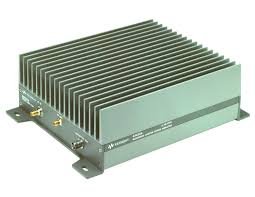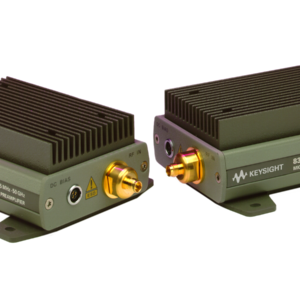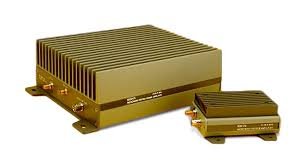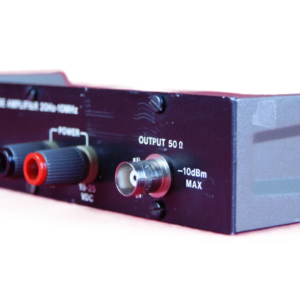
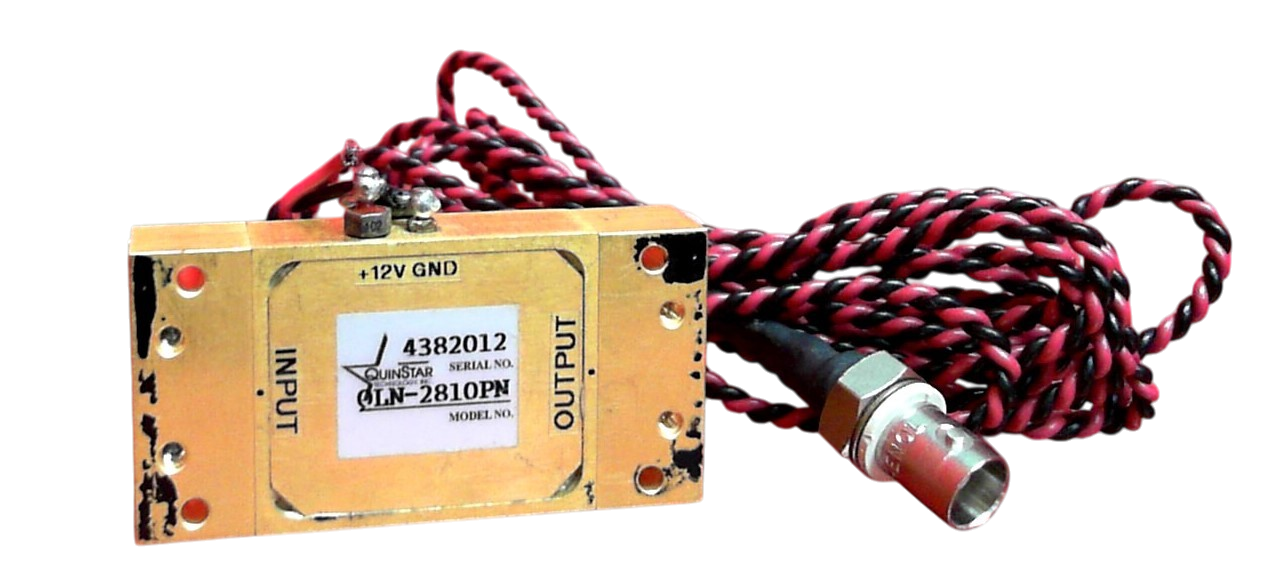

The Quinstar QLN-2810PN is a low-noise amplifier (LNA) engineered for millimeter-wave applications across the 18–104 GHz spectrum. Designated for operation around 28 GHz, this device leverages advanced MMICs and discrete components to deliver exceptional noise performance in demanding RF environments. The amplifier supports bandwidths up to 4 GHz and operates reliably across commercial and military platforms. QuinStar configures the QLN-2810PN with selectable gain and noise figure options tailored to specific frequency sub-ranges. Integral waveguide isolators are available to optimize input and output matching. The unit accommodates multiple connector architectures—coaxial ports (2.9 mm for 18–40 GHz, 2.4 mm for 40–50 GHz, 1.9 mm above 50 GHz) or waveguide ports spanning the full 18–104 GHz range—with custom hybrid configurations available upon specification.
Technical Specifications
• Operating Frequency Range: 18–104 GHz (QLN-2810PN optimized for ~28 GHz)
• Bandwidth: Up to 4 GHz per frequency interval
• Noise Figure: Variable by model and frequency range
• Gain: Variable by model and frequency range; typical options include 20 dB, 40 dB, or 50 dB
• Gain Flatness: ±1.0 dB (representative)
• Current Consumption: 100–180 mA typical, depending on gain configuration
• Connectors: Coaxial (2.9 mm/18–40 GHz, 2.4 mm/40–50 GHz, 1.9 mm/>50 GHz) or waveguide (18–104 GHz); custom combinations available
– Key Features
• Advanced MMIC and discrete device architecture
• Low-noise design optimized for weak-signal detection
• Optional integral waveguide isolators for impedance matching
• Multiple connector options and custom port configurations
• Broad frequency coverage within millimeter-wave band
– Typical Applications
• Satellite communications receivers
• Radar and sensing systems
• Instrumentation and test equipment
• Commercial and military RF systems
– Compatibility & Integration
The QLN-2810PN integrates into systems via standard coaxial or waveguide interfaces. Port selection and isolator options should be specified at order time to match system impedance and performance requirements.