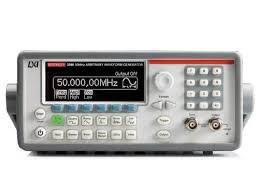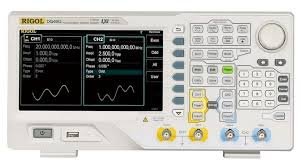

The Rigol DG4102 is a dual-channel arbitrary waveform generator delivering 100 MHz maximum sine frequency, built on Direct Digital Synthesizer (DDS) technology. It combines function generation, arbitrary waveform synthesis, pulse generation, harmonic generation, analog and digital modulation, and integrated frequency counter capabilities into a single benchtop instrument suited for electronic design, testing, and education.
Technical Specifications
Signal Generation
• Dual-channel, independent with synchronized phase adjustment
• Frequency range: 1 µHz to 100 MHz (sine); 1 µHz to 40 MHz (square); 1 µHz to 25 MHz (pulse); 1 µHz to 3 MHz (ramp); 1 µHz to 50 MHz (harmonics); 1 µHz to 25 MHz (arbitrary); up to 80 MHz bandwidth for noise
• Frequency resolution: 1 µHz
• Frequency stability: 2 ppm
• Phase noise: −115 dBc/Hz
• Sample rate: 500 MSa/s
• Vertical resolution: 14 bit
• Amplitude range: 1 mVpp to 10 Vpp (50 Ω load)
• DC offset: ±5 V (50 Ω load)
Waveform & Modulation
• 150 built-in waveforms including sine, square, ramp, pulse, noise, sinc, exponential, ECG, Gauss, video, and radar signals
• Arbitrary waveform memory: 16 kpts
• Harmonic generation: up to 16th order with independent frequency, amplitude, and phase control
• Analog modulation: AM, FM, PM
• Digital modulation: ASK, FSK, PSK, BPSK, QPSK, 3FSK, 4FSK, OSK, PWM
Frequency Counter
• Measurement range: 1 µHz to 200 MHz
• Measurements: frequency, period, positive/negative pulse length, duty cycle, with statistical history
– Key Features
• 7-inch TFT LCD display (800 × 480 pixels)
• USB Host and Device ports for waveform storage and PC control
• LAN interface conforming to LXI-C standards
• 10 MHz clock input/output and trigger I/O
• Modulation input available
• Operating temperature: 10°C to 40°C
• Compact benchtop form factor: 313 × 160.7 × 116.7 mm; 3.2 kg
• Power: 100–240 V AC
– Typical Applications
Electronic circuit design and verification; RF and analog signal simulation; educational laboratories; component characterization; signal integrity testing.
– Compatibility & Integration
LAN connectivity enables remote instrument control and integration into automated test systems. USB connectivity supports waveform transfer and PC-based programming. Clock and trigger I/O facilitate synchronization with external equipment.