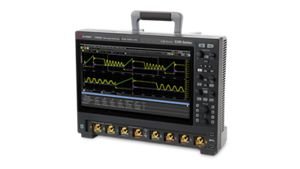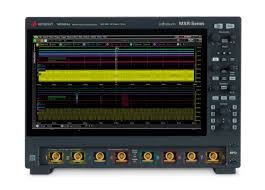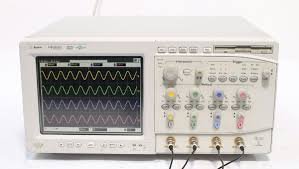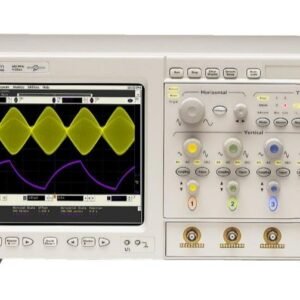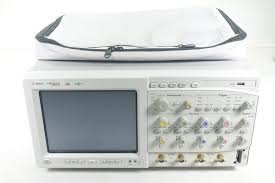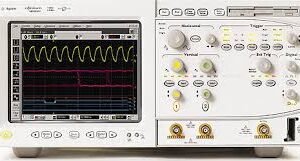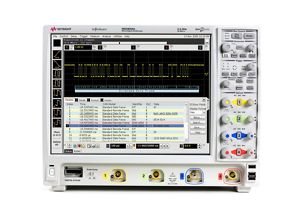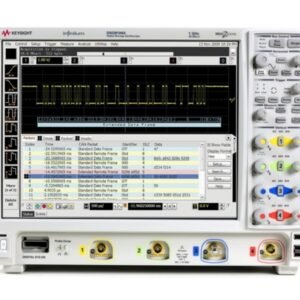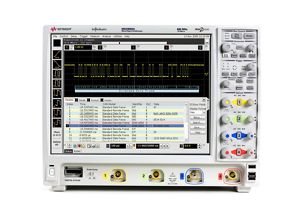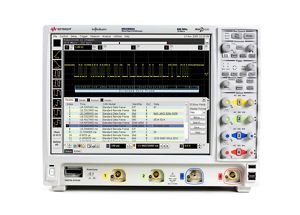
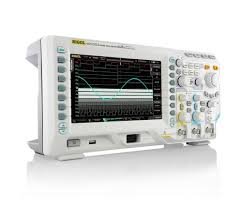

The Rigol MSO2202A-S is a mixed-signal oscilloscope that combines 200 MHz analog bandwidth with 16 digital channels and integrated 2-channel arbitrary waveform generation. Built for circuit analysis, embedded systems debugging, and signal characterization, it delivers 2 GSa/s sampling on analog channels with 14 Mpts record length, while the function generator covers sine signals to 25 MHz, square waves to 10 MHz, and arbitrary waveforms up to 16 kpts. The instrument supports eight trigger types across three acquisition modes and includes FFT analysis with selectable window functions, making it suitable for both development and production environments.
Technical Specifications
Oscilloscope Core
• Analog bandwidth: 200 MHz
• Analog channels: 2 with 8-bit vertical resolution
• Vertical sensitivity: 1 mV/div to 10 V/div
• DC measurement accuracy: ±3%
• Sample rate: Up to 2 GSa/s per channel
• Record length: Up to 14 Mpts per channel
• Timebase sweep: 5 ns/div to 100 s/div
• Input impedance: 1 MΩ ±2% || 15 pF ±5 pF
• Input coupling: DC, AC, Ground
Waveform Generator
• Channels: 2
• Sine output: Up to 25 MHz
• Square, Pulse, Noise: Up to 10 MHz
• Ramp: Up to 1 MHz
• Arbitrary waveforms: Up to 25 MHz, 16 kpts length
• Output amplitude: 5 mVpp to 10 Vpp (50 Ω load)
• Output offset: ±5 V (50 Ω load)
• Resolution: 14 bits at 125 MSa/s
• Modulation: AM, FM, PM, FSK, Sweep
Digital Channels (MSO)
• Channels: 16
• Logic threshold: Programmable (0 to V_max)
• Max input voltage: ±40 V DC coupled
• Input impedance: 1 MΩ || ~15 pF
– Key Features
• Edge, Pulse Width, Voltage, Logic, Pattern, Video, Duration, and Rise/Fall Time triggers
• Auto, Normal, and Single trigger modes
• 23 automatic measurements including frequency, rise/fall time, duty cycle, and phase
• FFT analysis with Rectangle, Hanning, Hamming, and Blackman window functions
• Waveform math operations: Add, Subtract, Multiply, Divide
• Sin(x)/x and Linear interpolation
– Typical Applications
• Embedded systems development and validation
• Mixed-signal circuit debugging
• Protocol analysis on digital buses
• Signal generation and characterization
• Power supply and timing measurements
– Compatibility & Integration
• USB Host for firmware updates and external storage
• USB Device for SCPI programming and remote control
• Ethernet (RJ-45) for LAN-based instrument control
• Trigger output (BNC) for external synchronization