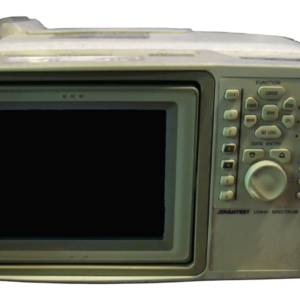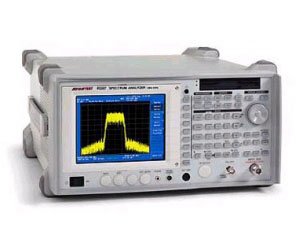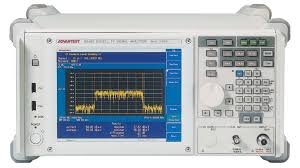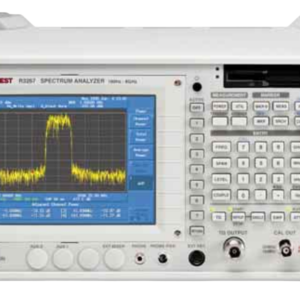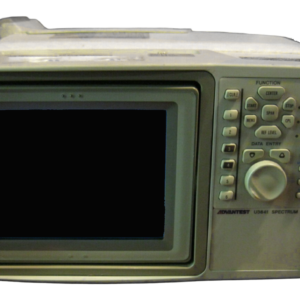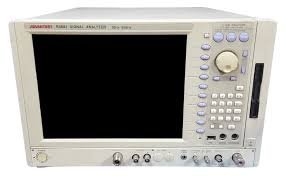

The Rohde & Schwarz FSIQ7 is a high-performance spectrum analyzer and integrated vector signal analyzer designed for signal characterization, research, and standards compliance verification across RF and microwave applications. It combines broadband frequency coverage from 20 Hz to 7 GHz with exceptional dynamic range and advanced modulation analysis capabilities, enabling precise measurement of complex signals in both frequency and time domains.
Technical Specifications
Frequency coverage spans 20 Hz to 7 GHz. Resolution bandwidth is selectable from 1 Hz to 10 MHz in 1/2/3/5 steps using 5-pole high-selectivity filters. FFT filter bandwidth operates from 1 Hz to 1 kHz for rapid measurements. Displayed average noise floor reaches -159 dBm typical at 10 Hz resolution bandwidth. Third-order intercept is +20 dBm with intermodulation-free dynamic range exceeding 110 dB. Adjacent channel power ratio performance includes 75 dB for WCDMA (4.096 MHz integration bandwidth) and 82 dB in alternate channels.
Total level uncertainty is less than 1 dB to 2.2 GHz and less than 1.5 dB to 7 GHz. Maximum input power is +30 dBm with 1 dB compression point at +10 dBm. Phase noise measures -150 dBc/Hz at 5 MHz offset and -107 dBc/Hz at 10 kHz offset.
Zero span sweep time is 1 µs for time-domain analysis, while full-span sweep time is 5 ms. Burst analysis includes gate functions, trigger delay, and integrated RF trigger capability. Display update rate reaches 25 sweeps per second. Noise figure is 15 dB typical. True RMS detector provides high-precision power measurement independent of waveform.
– Key Features
• Modulation analysis supports BPSK, QPSK, (G)MSK, 16QAM, AM, FM, PM up to 6.4 Msymbol/s
• Demodulation bandwidth to 2 MHz with adjustable cosine and root-cosine filters
• Modulation error metrics: EVM, phase error, frequency error, waveform factor, I/Q offset
• Mobile radio standards: WCDMA/3GPP, GSM, EDGE, IS-95
• Measurement outputs include I/Q signals, constellation diagrams, magnitude/phase, and numeric modulation error evaluation
• Power consumption: 210 VA
– Connectivity
Standard interfaces include USB, LAN, and GPIB. Optional interfaces support Ethernet (multiple connector types including RJ45), second IEC/IEEE bus interface, and removable/second hard disk storage.