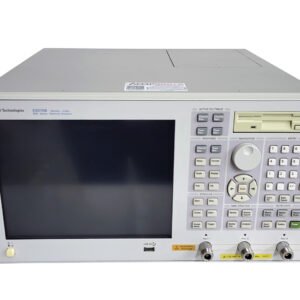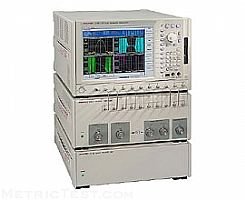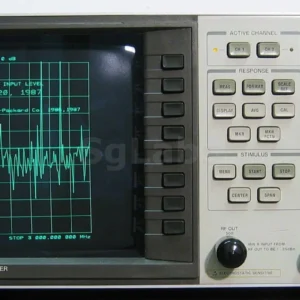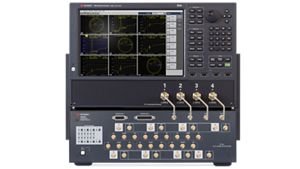

The Spirent TAS5100P is a network emulator that simulates real-world network conditions to validate infrastructure and service performance under realistic operational stress. It delivers granular control over latency, jitter, and packet loss across a wide range of network protocols and traffic types, enabling precise performance analysis and validation. The platform combines high-speed Ethernet capabilities with advanced emulation and filtering to test network behavior end-to-end.
Technical Specifications
Timestamp & Synchronization
• 2.5 ns transmit timestamp resolution with intra- and inter-chassis synchronization
Per-Port Real-Time Analysis
• Transmit and receive frame counts and rates
• Transmit and receive L1 byte counts and rates
• Out-of-sequence error detection
• PRBS error measurement
• Frame Check Sequence (FCS) errors and rates
• Minimum, maximum, and average latency across up to 16,383 streams
Protocol Support
• Layer 2: Ethernet II, 802.1Q, 802.1ad, FCoE
• Layer 3/4: IPv4, IPv6, TCP, UDP
• Data: HTTP, SIP, FTP, Unicast/Multicast RTSP, RAW TCP
• Authentication: 802.1x
• Video: MDI measurements
Ethernet Speeds
• 10 GbE, 40 GbE, and 100 GbE tri-speed operation (select modules)
• 400 GbE maximum supported
• RS-FEC and Auto-Negotiation
• PMD support: SR10, CR4, SR4, LR4
Module Variants
• dX2 modules: 100 GbE only or tri-speed (100/40/10 GbE)
• dX2-100G-P4 CFP2 form factor with optional CFP4 and QSFP28 adapters
• MX2-100GO-P4, FX2-100GO-P4, DX2-100GO-P4 (100 GbE only)
– Key Features
Emulation & Simulation
• Virtual Router simulation with DHCP and static IP assignment
• Routing table management and OSPF support for complex topology testing
• Advanced packet filtering by IP Protocol, MPLS, and VLAN tags
• Any Port to Any Port™ interconnectivity without port-to-port limitations
Interface & Control
• Windows-based GUI
• Tcl API support
– Typical Applications
Network infrastructure validation, service performance testing, topology simulation, and packet impairment analysis under controlled conditions.
– Compatibility & Integration
CFP2 optical modules with optional adapters for CFP4 and QSFP28 configurations. Reduced power consumption and form factor compared to CFP optics.