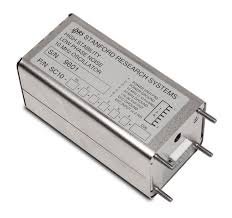

The Stanford Research Systems SC10 is a 10 MHz high-stability ovenized quartz oscillator engineered to deliver exceptional frequency accuracy and long-term stability for precision timing applications. Built around an SC-cut crystal with inherently low phase noise characteristics and controlled by an innovative electronic double oven temperature controller, the SC10 minimizes thermal gradients and maintains consistent performance across demanding measurement environments.
Technical Specifications
• Frequency: 10 MHz sine wave output
• Oscillator Type: High-stability ovenized quartz with SC-cut crystal
• Output Connectors: SMA, SMB, SMC, or single pin options
• Power Supply: Configurable +15 VDC or +24 VDC
• Warm-up Power Dissipation: 3.0 W @ 25°C (low-power variant available)
• Output Amplitude: Approximately 0.26 Vrms (0.7 Vpp at source)
– Key Features
Grade-selectable performance tiers accommodate application-specific stability and noise requirements. Grade A delivers aging rates as low as 2 × 10⁻¹⁰ per day with Allan variance of 2 × 10⁻¹² at 1 second integration time. Phase noise performance ranges from −130 dBc/Hz at 10 Hz offset (Grade A) through −120 dBc/Hz (Grade J), with −150 dBc/Hz at 100 Hz across all grades. Harmonic suppression reaches −45 dBc at the 2nd harmonic and −60 dBc for the 3rd and higher harmonics.
Flexible electronic frequency control (EFC) enables tuning adjustments without mechanical intervention. Temperature stability specifications remain valid across −10°C to +60°C operation; derating factors of 2× apply at temperature extremes (−10°C to 0°C and +50°C to +60°C), with 4× derating between −20°C and −10°C, and +60°C to +70°C.
Component accessibility throughout the design facilitates field servicing and maintenance.
– Typical Applications
Telecommunications, precision calibration standards, metrology labs, and frequency reference systems requiring sub-nanosecond aging rates and ultralow phase noise performance.
– Compatibility & Integration
Multiple connector options and configurable supply voltage enable integration into diverse system architectures. Grade selection allows cost-optimized procurement aligned to specification requirements without over-specification.