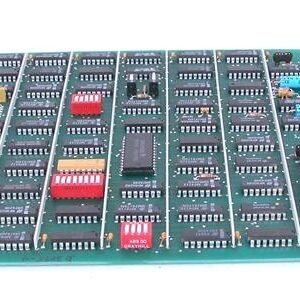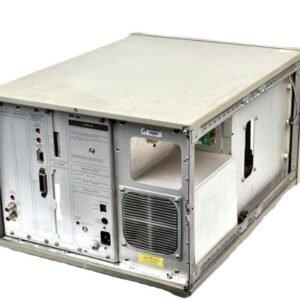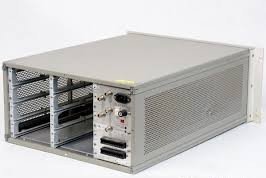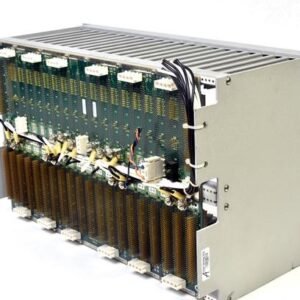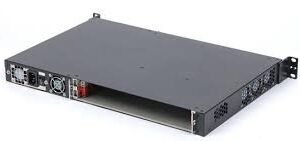

The Stanford Research Systems SIM900 Mainframe is a modular instrumentation platform that houses and controls up to eight Small Instrumentation Modules (SIMs) within a single, compact unit. It serves as the central hub for custom-configured measurement and control systems, providing regulated power distribution, computer interfaces, clock synchronization, and status monitoring. The mainframe accommodates both single-width and double-width modules, with an additional external module port for applications requiring close proximity to measurement equipment.
Technical Specifications
Module Configuration
• Eight internal slots for SIM modules
• Single-width and double-width module support
• One external module port via rear-panel connector and interconnect cable
Power Distribution
• Output voltages: ±5 VDC, ±15 VDC, +24 VDC
• Total power budget: 70 W (all voltages combined)
• Voltage regulation: ±0.5%
• Current limits: +5 VDC at 5 A max; −5 VDC, ±15 VDC, and +24 VDC at 3 A max
• Input supply: 90 VAC to 260 VAC, 47 Hz to 63 Hz
• Over-voltage and short-circuit protection with current limiting and trip-off circuit
• Forced air cooling for thermal stability
Clock and Synchronization
• Internal 10 MHz master clock (VCXO-based, ±10 ppm stability)
• Optional external 10 MHz timebase input (rear-panel BNC, Option 02)
• Phase-locked loop with ±10 ppm (±100 Hz) capture range
• External reference input acceptance: 1 V to 5 V peak-to-peak amplitude
• Timebase status indicators: Internal 10 MHz, External Lock, External Fault
Memory & Control
• 4000-byte non-volatile memory for start-up scripts
• Auto-execution of initialization scripts on power-up
Interfaces
• Primary host connection: RS-232 (DB9/F DCE) or optional GPIB (IEEE-488.2)
• Two auxiliary RS-232 ports (DB9/M DTE) for cascading mainframes or controlling external instruments
• One eavesdrop RS-232 port
• DIP switch selection for host interface and configuration settings
• Only one primary host interface active at power-on
– Key Features
• Flexible module accommodation handles mixed single and double-width configurations
• Low-noise clock distribution prevents inter-module mixing artifacts
• External timebase capability enables phase-locking to precision standards
• Multiple cascading and monitoring ports support multi-frame systems
• Well-regulated, current-limited supplies protect connected modules
• Universal mains input eliminates regional power supply requirements
– Typical Applications
• Custom multi-module measurement systems requiring synchronized operation
• Laboratory instrumentation platforms combining lock-in detection, signal generation, and data acquisition
• Distributed measurement setups with modules positioned remotely via external port
• Systems requiring phase-coherence with external frequency references
– Compatibility & Integration
The SIM900 operates with all Stanford Research Systems Small Instrumentation Modules. External timebase synchronization enables integration with precision frequency standards such as the SIM940 Rubidium Standard. RS-232 cascading supports multi-mainframe configurations for expanded module capacity.