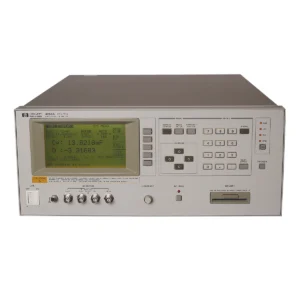
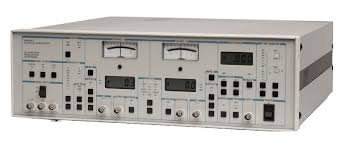

The Stanford Research SR530 is a dual-phase lock-in amplifier engineered to recover AC signals buried in noise across the 0.5 Hz to 100 kHz band. It simultaneously measures in-phase (X) and quadrature (Y) components using precision analog sine-wave demodulation, free from harmonic distortion. With input noise as low as 7 nV/√Hz (voltage) and 0.13 pA/√Hz (current), the SR530 resolves signals at nanovolt and femtoampere scales.
Technical Specifications
Signal Detection & Demodulation
• Frequency range: 0.5 Hz to 100 kHz
• Dual-phase lock-in architecture with simultaneous RCOSØ and RSINØ outputs
• Analog sine-wave multiplier demodulation (harmonic-free)
• Dynamic reserve: up to 80 dB (20, 40, 60 dB ranges; +20 dB with band-pass filter)
Input Specifications
• Differential inputs; selectable voltage or current mode
• Voltage input impedance: 100 MΩ + 25 pF (AC coupled)
• Voltage input noise: 7 nV/√Hz at 1 kHz
• Full-scale sensitivity (voltage): 100 nV to 500 mV
• Full-scale sensitivity (current): 100 fA to 0.5 pA
• Current input gain: 10⁶ V/A
• Current input noise: 0.13 pA/√Hz at 1 kHz
• Common-mode rejection: 100 dB (DC to 1 kHz, −6 dB/octave above 1 kHz)
• Maximum voltage input: 100 VDC; 10 VAC damage threshold; 2 Vpp saturation
• Maximum current input: 10 pA damage threshold; 1 pApp saturation
Filtering
• Line notch filter: 50 dB rejection (45–65 Hz adjustable)
• Second harmonic notch filter: 50 dB rejection
• Tracking band-pass filter: automatic frequency tracking
• Time constants: 1 ms to 100 seconds (two cascaded stages)
• Rolloff: 6 or 12 dB/octave
Reference
• External reference: sine wave or pulsed edges (0.5 Hz to 100 kHz)
• Harmonic detection at fundamental and second harmonic
• Optional internal oscillator: 0.01, 0.1, or 1 Vrms amplitude; 20 mA drive capability
– Key Features
• Nanovolt sensitivity with differential input architecture
• Inherently linear analog multiplier eliminates harmonic artifacts
• Dual notch filters suppress line-frequency interference
• Selectable dynamic reserve optimizes signal-to-noise in high-interference environments
• Configurable time constants enable trade-off between settling speed and noise reduction
– Typical Applications
Low-level AC signal measurement in photometry, electrochemistry, materials characterization, and precision impedance analysis.
– Compatibility & Integration
External reference input accepts standard function generators or pulsed signals. Optional internal VCO provides self-contained operation without external reference infrastructure.