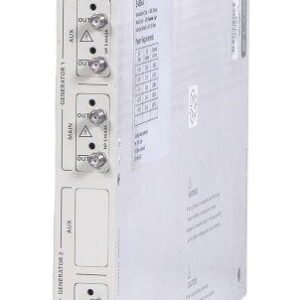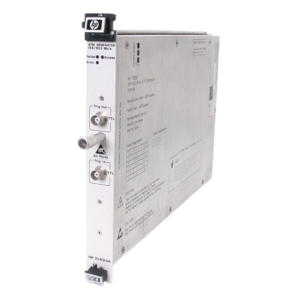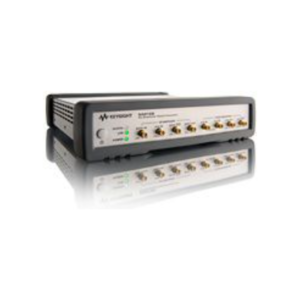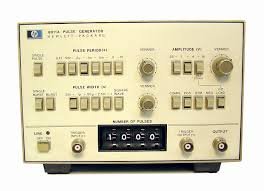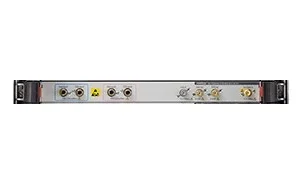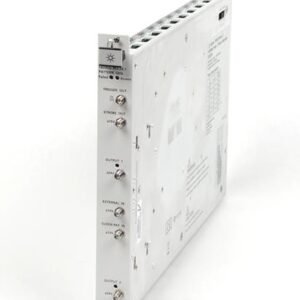

The Tektronix PPG1604 is a 4-channel programmable pattern generator engineered for high-speed digital communications testing up to 16 Gb/s per channel. It generates PRBS and user-defined patterns with differential outputs on 2.92 mm connectors, making it ideal for receiver characterization, multi-channel validation, and crosstalk immunity assessment across 100 Gigabit Ethernet, 32G Fibre Channel, and PAM4 applications.
Technical Specifications
Data Rate & Channels
• Maximum data rate: 16 Gb/s per channel
• Channel count: 4
• Internal clock frequency range: 16 GHz to 32 GHz
Output Characteristics
• Output amplitude: 250 mV to 2.0 V single-ended; 600 mV to 2.0 V differential
• Offset window: Programmable from −2 V to +3 V
• Termination voltage: Programmable from −2.0 V to +3.3 V at 50 Ω
• Crossing point: 35% to 65% programmable
• Rise/fall time (20% to 80%): 11 ps typical
• Rise/fall time (10% to 90%): 16 ps typical
• Output connectors: 2.92 mm; DC coupled differential
Jitter Performance
• Inherent jitter (RJ): <250 fs RMS typical
• Jitter insertion: BUJ, SJ, RJ, and PJ options available
• High-frequency jitter (HFJIT): Available option
• BUJ amplitudes: Up to 50 psp-p with modulation rates to 2.5 Gb/s (with Option HFJIT)
Clocking & Control
• Clock output: AC coupled, one full cycle per data bit
• Control: Front panel touch screen GUI or USB computer control
• Compliance: IEEE Standard 488.1-1987 and RS-232-C
– Key Features
• Four independent differential output channels with programmable amplitude and offset
• Pattern support for PRBS and custom sequences
• Jitter injection options for receiver stress testing
• Programmable crossing point and termination voltage
• AC coupled clock output at full data rate
– Typical Applications
• Multi-channel 25 Gb/s testing for 100 G Ethernet
• DQPSK and DP-QPSK signal generation
• CFP2 and CFP4 module testing
• Multi-level signal characterization
• Semiconductor and component receiver validation
• Crosstalk immunity assessment
– Compatibility & Integration
The PPG1604 integrates via USB or IEEE 488.1-1987 interfaces. Maximum power consumption is 720 W with T 4A 250V fusing.