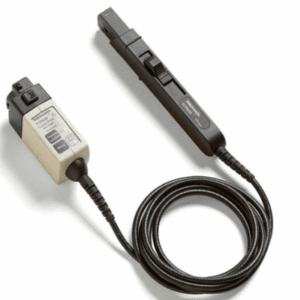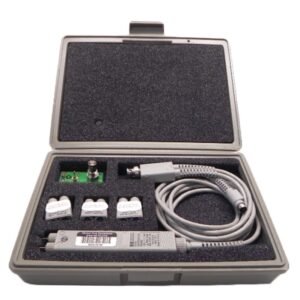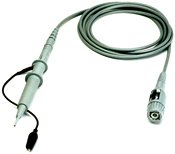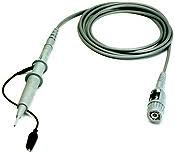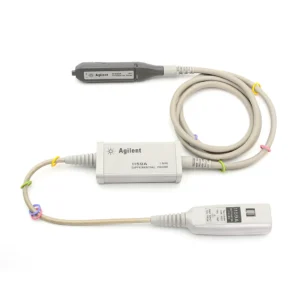

The Yokogawa 701925 PBDH0500 is a high-performance differential probe engineered for precision measurement of floating and differential signals in demanding test environments. Offering DC to 500 MHz bandwidth with a ±25 V maximum differential input rating, this 50:1 attenuation probe delivers the dynamic range and frequency response required for high-speed signal acquisition including CAN FD waveforms and similar differential protocols.
Technical Specifications
Electrical Performance
• Bandwidth: DC to 500 MHz (−3 dB)
• Attenuation Ratio: 50:1
• Input Resistance: 1 MΩ
• Input Capacitance: 1.1 pF
• Maximum Differential Input Voltage: ±25 V (DC + AC peak)
• Maximum Operating Input Voltage: ±35 V (DC + AC peak)
Physical & Interface
• Probe Length: 1200 mm
• Connector: Yokogawa dedicated probe interface
• Power: Supplied via Yokogawa probe interface; auto-recognized by compatible oscilloscopes
– Key Features
The 50:1 attenuation ratio balances sensitivity with measurement headroom, while the 1 MΩ input impedance and 1.1 pF input capacitance minimize circuit loading during acquisition. The probe’s 1200 mm length provides adequate reach for bench-top and production test setups. Wide voltage operating margin—capable of handling ±35 V maximum despite a ±25 V differential rating—accommodates transient overvoltage conditions common in switching and power electronics testing.
– Typical Applications
This differential probe is suited for CAN FD bus analysis, high-speed digital signal monitoring, floating ground measurements, and differential switching node characterization in power conversion circuits. The DC-coupled bandwidth supports both transient and steady-state signal capture across 500 MHz.
– Compatibility & Integration
Designed exclusively for Yokogawa oscilloscopes with dedicated probe interfaces. The probe connector integrates power delivery and signal routing, eliminating external power requirements. Automatic oscilloscope recognition simplifies instrument configuration. A full accessory kit—including 10 cm and 5 cm pair leads, micro clips, ground extensions, multiple pin styles, and color markers—enables rapid probe tip adaptation across diverse test points.