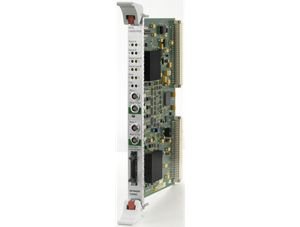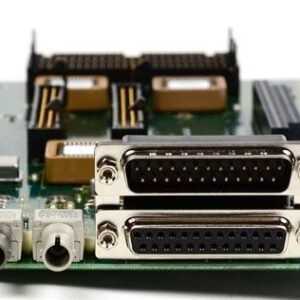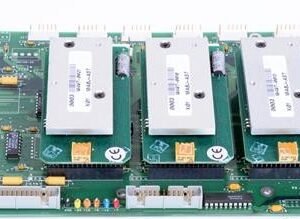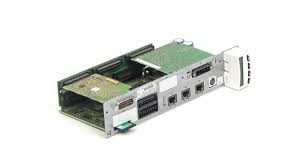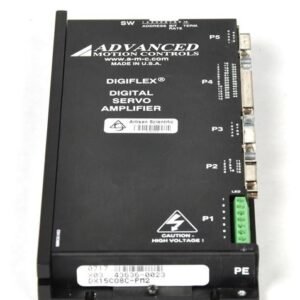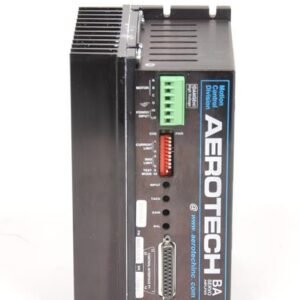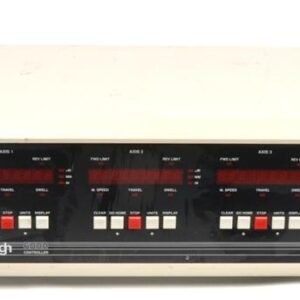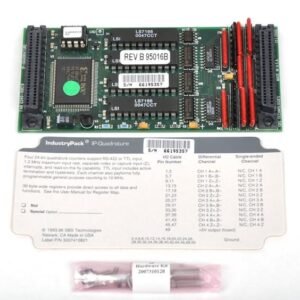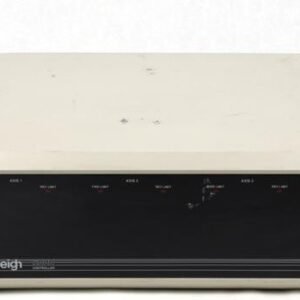


The PCX/DSP is a C-programmable motion controller implemented as a single-slot ISA card, delivering real-time servo and stepper control for up to 8 axes. Built around an Analog Devices 40 MHz DSP processor, it executes motion algorithms on-board while communicating with the host at up to 1.2 Mbytes/sec across the ISA bus. The architecture offloads real-time functions to dedicated hardware, freeing the host CPU for non-real-time tasks.
## Technical Specifications
• **Processor:** Analog Devices 40 MHz DSP
• **Axes Controlled:** Up to 8 (servo or stepper)
• **Servo Output Resolution:** 16-bit
• **Encoder Input:** Up to 5 MHz
• **Step/Direction Output:** 375 kHz
• **Analog Inputs:** 8 channels, 12-bit resolution
• **ISA Bus Communication:** Up to 1.2 Mbytes/sec
• **On-Board Motion Buffer:** 600 frames maximum (20 words per frame)
• **User I/O:** Up to 44 lines, configurable in groups of 8
## Key Features
• Motion profiles include trapezoidal, S-curve, parabolic, and custom trajectories
• Second-order PID control with velocity, acceleration, and friction feed-forward
• Optional post-PID notch filter for mechanical resonance suppression
• Electronic gearing and camming algorithms
• Dual-loop control architecture
• Circular and linear interpolation
• Dedicated limit, home, fault, and enable signals per axis
## Software & Programming
Development uses the Motion Developer’s Kit (MDK) with over 250 MEI standard C function libraries. Supports Microsoft, Borland, Watcom, and Symantec compilers. Compatible with Windows NT, Windows 95, Windows 3.X, DOS, VxWorks, Lynx/OS, pSOS, and QNX.
## Compatibility & Integration
ISA bus interface connects directly to PC-based systems. Configurable user I/O accommodates both motion control signals and discrete logic interfacing. Multi-compiler support enables integration into diverse development environments.