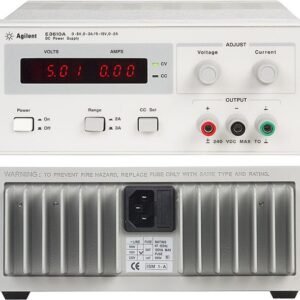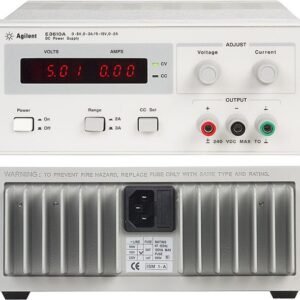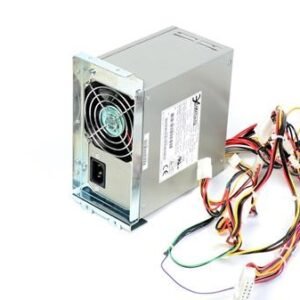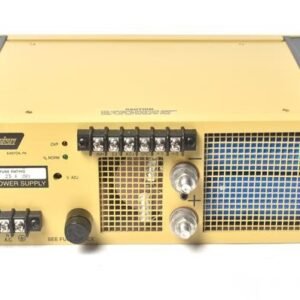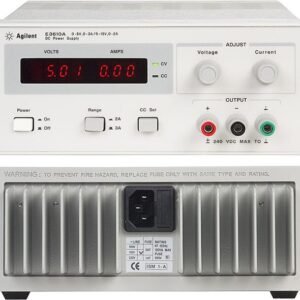
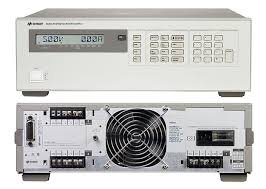

The Hewlett Packard 6626A is a precision four-output programmable DC power supply engineered for system integration and automated electronic testing. Each of its four isolated linear outputs delivers low-noise power with 14-bit programming and readback resolution for both voltage and current, enabling precise control across a wide range of load conditions. Built-in GPIB interface supports remote operation and integration into automated test systems. The 3U rackmount form factor optimizes density in instrument racks.
Technical Specifications
Output Configuration
The 6626A provides four independently programmable outputs, each selectable between low and high voltage ranges. High-range outputs deliver 0–50 V with current capability to 1 A (or 0–16 V at 2 A), while low-range outputs provide 0–16 V at 200 mA. Total system power is limited to 550 W maximum.
Precision and Stability
Voltage programming accuracy reaches 0.016% + 10 mV (high range) and 0.016% + 53 mV (low range). Current readback achieves 0.04% + 500 µA (high range) and 0.04% + 185 µA (low range). Load and line regulation each measure 0.5 mV for voltage and 0.005 mA for current, ensuring tight output stability across line and load variations.
Noise Performance
Voltage ripple across the 20 Hz to 20 MHz bandwidth measures 500 µV RMS and 3 mV peak-to-peak. Current ripple is held to 0.1 mA RMS, supporting sensitive analog and RF circuitry.
– Key Features
• Four isolated linear outputs with dual-range voltage selection
• 14-bit programming resolution for voltage and current
• GPIB interface for automated system control
• Low-noise linear topology—ideal for precision analog measurements
• Compact 3U high rackmount package
• 550 W total available power
– Physical and Electrical
Dimensions: 16.75 in × 5.22 in × 19.6 in. Input power requirement is 550 W maximum. The unit meets Safety Class 1 requirements with protective earth grounding and complies with Low Voltage Directive 73/23/EEC and EMC Directive 89/336/EEC.
– Typical Applications
Precision circuit characterization, automated test benches, component qualification, and subsystem power delivery where noise rejection and independent output control are critical.