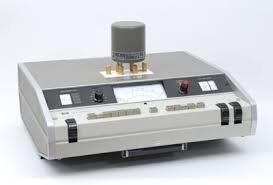

The HP/Agilent 4342A is a solid-state Q-meter engineered for precision measurement of quality factor (Q) in inductors, capacitors, and resonant circuits across a broad frequency spectrum. This instrument delivers direct-reading Q measurements, dissipation factor and dielectric constant determination for insulating materials, transformer coupling coefficient analysis, and RF resistance and reactance calculations. Elimination of fragile thermocouple components ensures operational durability across diverse test environments.
Technical Specifications
Frequency Range: 22 kHz to 70 MHz (standard); optional 10 kHz to 32 MHz (Option 001). RF accuracy ±1.5% from 22 kHz to 22 MHz; +2% from 22 MHz to 70 MHz; +1% at L-point reference. Seven sub-ranges provide approximately 1% resolution increments.
Q Measurement: Range 5 to 1000 across four overlapping sub-ranges (5–30, 20–100, 50–300, 200–1000). Delta-Q (ΔQ) spans 0 to 100 with ±10% full-scale accuracy. Upper scale resolution 0.1 (0–10); lower scale 0.05 (0–3).
Resonating Capacitor: Main dial 25 to 470 pF with ±1% or 1 pF accuracy (whichever greater); vernier dial ±5 to +5 pF with ±0.1 pF accuracy. Increments: 1 pF (25–30 pF), 2 pF (30–200 pF), 5 pF (200–470 pF) on main dial; 0.1 pF on vernier.
Inductance (L): Direct-reading 0.09 µH to 1.2 H at seven specified frequencies.
Power: 25 VA maximum (40 VA maximum per updated specification). 115 or 230 V ±10%, 50–400 Hz.
Operating Temperature: 0°C to 50°C.
– Key Features
• Push-button frequency range selection and Q/ΔQ switching
• Direct-reading expanded scale for Q measurements
• Solid-state signal detection—no thermocouple thermal drift
• Dual-dial capacitor tuning with fine vernier adjustment
– Typical Applications
• Component Q and dissipation factor characterization
• Dielectric constant measurement of insulating materials
• Transformer coupling coefficient and frequency response analysis
• Mutual inductance and RF impedance determination
– Compatibility & Integration
Standard mains operation (115/230 V, 50–400 Hz) supports laboratory integration. Low power consumption accommodates multi-unit test setups.