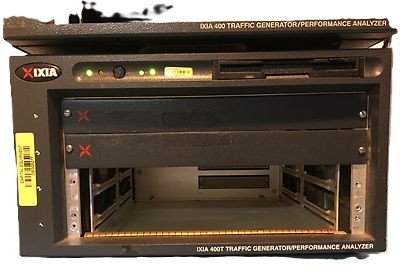

The Ixia 400T is a 4-slot desktop chassis that delivers high-performance network traffic generation and analysis across Layers 2–7. This modular platform accommodates various load modules to simulate and validate complex network scenarios, making it essential for testing network infrastructure, applications, and security devices. The 400T supports synchronized traffic generation and analysis across thousands of ports with real-time packet-by-packet latency measurement and 32,000 traffic flows per port. Multiple chassis can be daisy-chained up to 256 units with timing synchronized to within 10 nanoseconds, enabling large-scale distributed testing.
Technical Specifications
• Chassis Configuration: 4 slots, desktop form factor
• Traffic Generation & Analysis: Multilayer protocol support (IP, TCP, UDP, IPX, IGMP, ARP, DHCP, RIP, ISL, MPLS, OSPF, BGP-4, IS-IS) with simultaneous Layer 2–7 testing
• Port Density: Up to 32,000 traffic flows per port; exact port count depends on installed load modules
• Scalability: Up to 256 daisy-chained chassis with 10 nanosecond timing synchronization
• Power Consumption: Maximum 350 W
• Power Input: 4 AMP @ 110 VAC; 2 AMP @ 220 VAC
– Key Features
• Real-time packet-by-packet latency measurement and analysis
• Tcl scripting support for automated test suites (RFC2544, RFC2285 compatible)
• Integrated Windows XP Pro–based PC controller for local management and remote TCP/IP access
• Compatible with IxNetwork and IxLoad software platforms
• IxWeb application support for Layer 4–7 device verification
– Load Module Support
The 400T accommodates load modules across multiple technology domains: 10/100 Ethernet, Gigabit Ethernet (GBIC, SFP, RJ45), 10 Gigabit Ethernet, Packet Over SONET (OC-12, OC-48, OC-192), BERT modules, and combo POS/BERT/10 GbE configurations. Module density per slot varies by type (typically 2–4 modules per slot).
– Typical Applications
Network device validation, application performance testing, security appliance verification, and carrier-grade protocol compliance testing across enterprise and service provider environments.