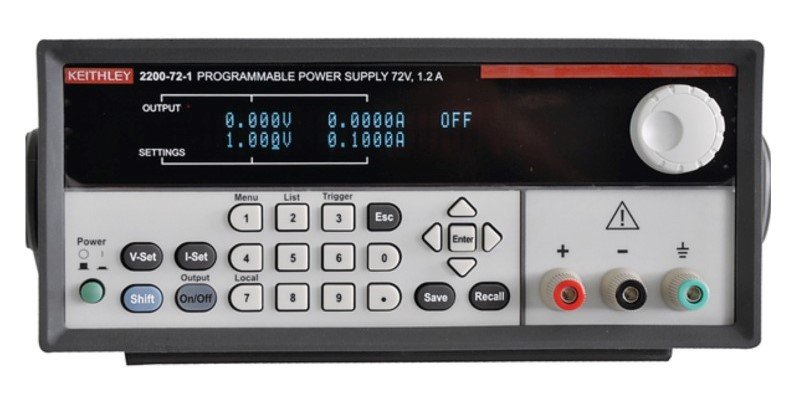

The Keithley 2200-72-1 is a single-channel, programmable DC power supply delivering 0V to 72V at up to 1.2A with 86W total output. This linear supply combines low-noise performance with high measurement accuracy, making it suitable for component testing, circuit development, and automated test environments. Voltage setting accuracy reaches ±0.03% + 6mV under remote sensing at 25°C ± 5°C, while current setting accuracy is ±0.05% + 1mA. Output ripple and noise remain below 1 mVRMS and 3 mVp-p across the 20 Hz to 7 MHz band.
Technical Specifications
Output voltage spans 0V to 72V with 1 mV resolution; output current ranges 0A to 1.2A with 0.1 mA resolution. Voltage readback accuracy is ±0.02% + 5mV, and current readback accuracy is ±0.05% + 1mA. Load regulation maintains less than 0.01% + 2mV for voltage and less than 0.05% + 0.5mA for current. Line regulation is below 0.01% + 1mV (voltage) and below 0.05% + 0.1mA (current). Current ripple and noise remain under 3 mARMS. The unit accepts 99–132 VAC at 110V AC setting or 198–264 VAC at 220V AC setting, both at 50/60Hz input frequency. Power consumption is 250VA.
– Key Features
• Programmable over-voltage protection (OVP) with output clamping below 1V at limit
• Programmable over-current protection (OCP)
• Remote voltage sensing compensates for lead drops and ensures accurate load voltage
• Dual-line vacuum fluorescent display shows programmed and actual values simultaneously
• 40 setup memories for fast configuration recall
• List mode supports up to 7 lists with 80 steps each, enabling voltage limit, current limit, and duration control for repeatable test sequences
• Floating output rated to 100V DC + peak AC relative to earth ground
– Typical Applications
Component characterization, bench testing of sensitive circuits, automated test system integration, and development workflows requiring stable, low-noise DC power delivery.
– Compatibility & Integration
Standard GPIB and USB interfaces enable remote programming and automated control within ATE systems. Front and rear output terminals accommodate both benchtop operation and integrated test rack configurations.