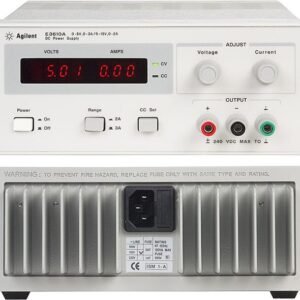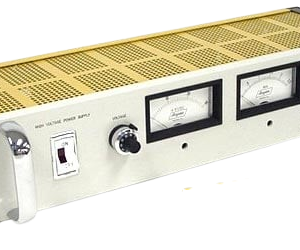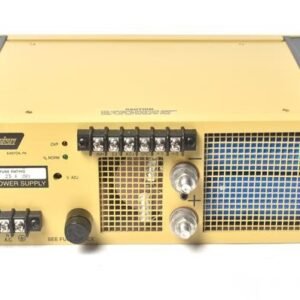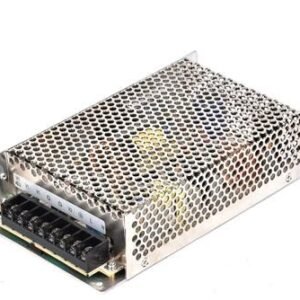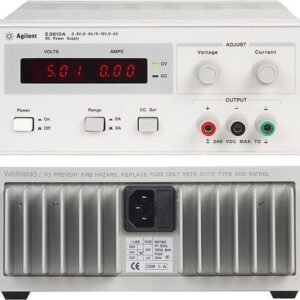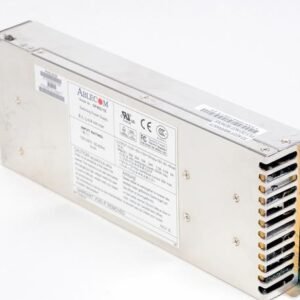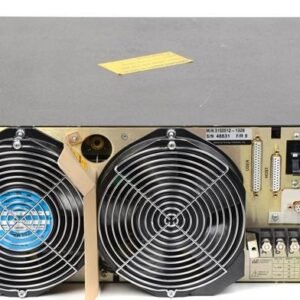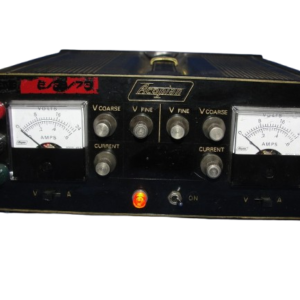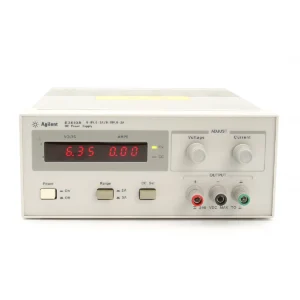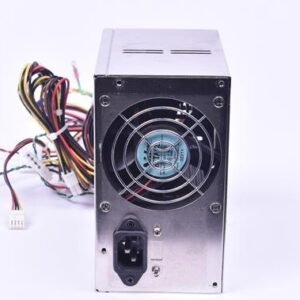

The TDK-Lambda EMI TCR600S1 is an SCR phase-controlled DC power supply engineered for industrial environments requiring stable, filtered output in electromagnetically noisy conditions. This single-phase unit delivers 0–600 V at 0–1 A (TCR600S1.6-1) or 0–4.5 A (TCR600S4.5) with constant voltage/constant current regulation and internal RFI/EMI filtering using ferrite toroidal chokes and VDE-listed capacitors. Regulation precision holds within ±0.1% across 50–100% output and ±0.05% below 50% under fixed line, load, and temperature conditions.
Technical Specifications
• Output: 0–600 V, 0–1 A or 0–4.5 A; 600 W maximum
• Input: 115 VAC (105–130 V operating range), 47–63 Hz; optional 100 V, 200 V, 208/220 VAC configurations available
• Input current: 9.5 A maximum (600 W model)
• Regulation: Constant voltage or constant current with automatic crossover; ±0.1% (50–100%), ±0.05% (<50%)
• Output ripple: 750 mV maximum at full load (TCR600S4.5)
• Transient response: 30% load step settles within 2% in 75 ms
• Stability: ±0.05% of setpoint for 8 hours post-warm-up
• Temperature coefficient: 0.02%/°C (voltage), 0.03%/°C (current)
• Dielectric withstand: 2500 V rms (primary to secondary and chassis)
• Soft-start: Integrated to eliminate magnetic inrush current
– Key Features
• SCR phase control for efficient output modulation
• Internal RFI/EMI filtering with ferrite chokes and VDE-certified capacitors
• Dual regulation modes with seamless CV/CC transition
• 10-turn voltage control; single-turn current control
• Analog or optional digital metering
• Optional over-voltage protection (50–110% adjustable setpoint)
• Compact, durable construction for industrial duty
– Typical Applications
Laboratory testing, power conditioning in RF/EMI-sensitive environments, industrial process control, load bank simulation, and equipment validation where regulated DC and filtered AC input are required.
– Compatibility & Integration
Standard 115 VAC input; alternative voltages available. Analog control inputs and optional digital panel meters support integration into automated test stations and control systems.