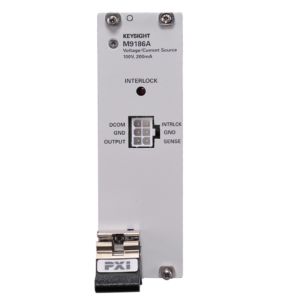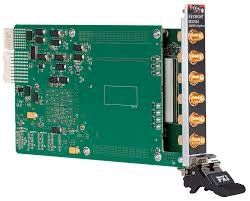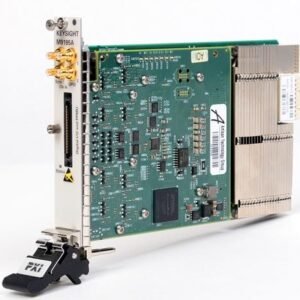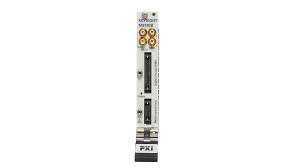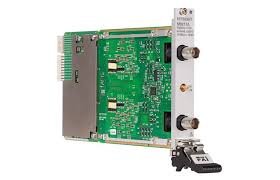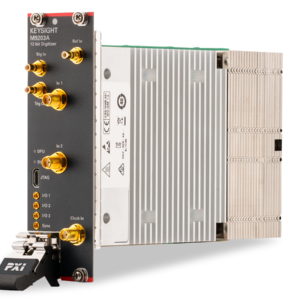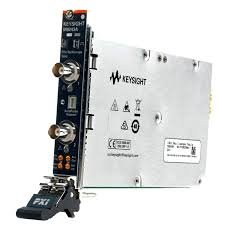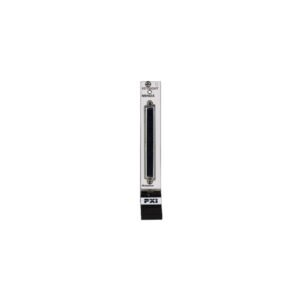

The PXI-8432/4 is a 4-port RS-232 serial interface module for PXI systems delivering isolated, high-speed serial communication. Each port supports configurable baud rates from 57 to 1,000,000 baud with 0.01% accuracy at standard rates. Port-to-port and port-to-host isolation reach 60 VDC continuous (CAT I) with 2000 Vrms withstand capability, protecting connected equipment from ground loops and transient voltages.
Technical Specifications
• Serial Standard: RS-232, 4 isolated ports
• Baud Rate Range: 57 to 1,000,000 baud
• Baud Rate Accuracy: 0.01% (standard rates), 1% (nonstandard)
• Maximum Throughput: 1 Mbps per port
• I/O FIFO Buffer: 128 bytes transmit and receive
• Connectors: 10-Position Modular Jack (10P10C); four DE9M cables included
• Data Transfer: High-speed DMA engine with multithreading and multiprocessor support
• Isolation: 60 VDC continuous, 2000 Vrms withstand (5 s dielectric test)
• Power Consumption: +5 VDC at 925 mA typical, 2 A maximum
• Operating Temperature: 0 to 55 °C
• Physical: 3U, 16.0 × 10.0 cm, 147 g
– Key Features
• Galvanic isolation between all four ports and the PXI host eliminates noise coupling in multi-instrument configurations
• 128-byte FIFOs reduce CPU load during sustained serial transfers
• Configurable baud rates accommodate legacy equipment and modern high-speed protocols
• Internally powered from the PXI +5 VDC rail—no external supply required
• MXI compatible for remote chassis operation
– Typical Applications
• Industrial device control and telemetry in noisy environments
• Multi-instrument data acquisition systems requiring isolated serial links
• Legacy equipment integration in automated test systems
• Real-time applications leveraging LabVIEW RT deployment
– Compatibility & Integration
The module operates as standard COM ports under Windows and Real-Time OS, enabling use with existing serial software without driver modification. LabVIEW RT support simplifies integration into deterministic test applications. Safety compliance includes IEC 60950-1, EN 60950-1, UL 60950-1, and CAN/CSA-C22.2 No. 60950-1.