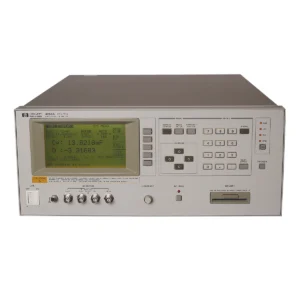

The North Atlantic 214C is a phase angle voltmeter that measures voltage magnitude and phase angle in AC signals with direct readings across five functions: total voltage, fundamental voltage, in-phase voltage, quadrature voltage, and phase angle. Built as a solid-state instrument, it delivers ±2% full scale voltage accuracy and ±1° phase dial accuracy, making it well-suited for resolver-based system testing and calibration. Transformer-isolated signal and reference inputs minimize measurement errors in electrically noisy environments.
Technical Specifications
• Voltage measurement: 300 µV to 300 V across 13 ranges
• Voltage accuracy: ±2% full scale
• Phase angle accuracy: ±1° on dial
• Phase sensitive bandwidth: ±5%
• Excitation voltage: 2.0 to 28 Vrms, transformer isolated
• Output voltage: Varies directly with excitation
• Minimum load impedance: 10 kΩ (2.0–20.0 Vrms); 15 kΩ (20.0–28.0 Vrms)
• Output regulation: 2% maximum
• Input impedance (excitation): 50 kΩ minimum
– Key Features
• Frequency range: 10 Hz to 100 kHz overall; phase-sensitive operation from 30 Hz to 10 kHz or 30 Hz to 20 kHz with field-changeable modules
• Field-replaceable modules enable 1, 2, 3, or 4 selectable frequencies without full recalibration
• Single rear-panel adjustment recalibrates the instrument when modules are changed
• Configurable 3/4-wire or 2-wire input/output connections
• Front panel controls for immediate voltage range and function selection
– Typical Applications
• Resolver system testing and calibration
• AC voltage and phase angle measurement in control and instrumentation circuits
• Precision phase-sensitive measurements where signal isolation is critical
– Compatibility & Integration
Field-changeable module architecture allows adaptation to specific frequency requirements without hardware replacement. Transformer-isolated outputs enable direct integration into low-impedance measurement chains.