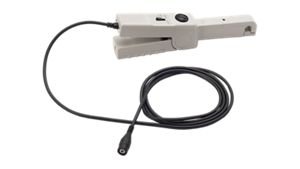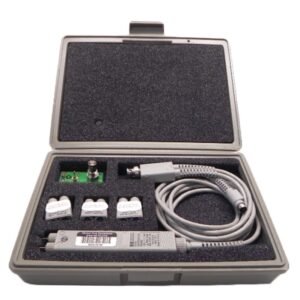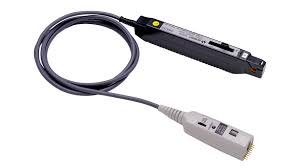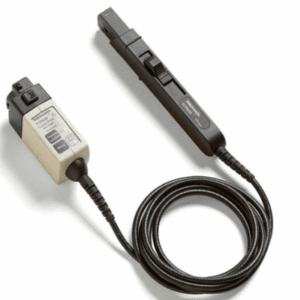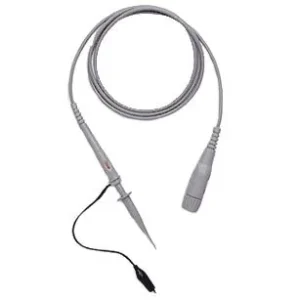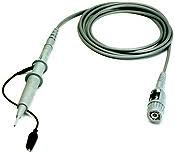
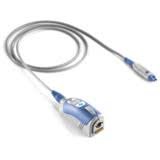

The Rohde & Schwarz RT-ZD40 is an active differential probe engineered for precision measurement of high-frequency differential signals from DC to 4.5 GHz. It delivers high input impedance (1 MΩ || 0.4 pF) and low input capacitance to minimize circuit loading while maintaining excellent signal fidelity across demanding applications in signal integrity, high-speed digital design, and power electronics.
Technical Specifications
• Bandwidth: DC to 4.5 GHz
• Attenuation Factor: 10:1
• Input Impedance (Differential): 1 MΩ || 0.4 pF
• Maximum Input Voltage (Between Signal Sockets): ±5 V with ±5 V offset compensation
• Maximum Input Voltage (Each Signal Socket to Ground): ±8 V with ±22 V offset compensation
• Maximum Non-Destructive Input Voltage: ±30 V
• Dynamic Range (Differential Input): ±5 V with ±5 V offset capability
• Operating Voltage Window (Each Pin to GND): ±8 V with ±22 V common mode offset capability
• ProbeMeter Measurement Error: <0.1 %
• Cable Length: 1.2 m
– Key Features
• High common-mode rejection suppresses interference in high-clock-rate systems
• Very low added noise for error-free broadband signal transmission
• Integrated high-precision DC voltmeter with ProbeMeter functionality
• Temperature-stable performance with extremely low zero and gain drift
• Variable pitch width for connection to diverse devices under test
• Integrated micro button for instrument control
– Typical Applications
• Signal integrity analysis on high-speed digital designs
• Power electronics measurements requiring differential coupling
• Common-mode noise rejection in broadband signal environments
• Non-invasive probing where circuit loading must be minimized
– Compatibility & Integration
The probe connects via Rohde & Schwarz probe interface using a male precision 7 mm BNC connector and six pogo pins for supply voltage, analog signal transmission, and digital data. Direct integration with compatible Rohde & Schwarz oscilloscopes provides software-controlled operation. An optional adapter enables use with base units lacking the native probe interface. Supported oscilloscopes are detailed in the product datasheet.